How Small NP Practices Should Evaluate Physician Collaboration Support
📌 Key Takeaways
The author recommends that small NP practices demand written proof, clear task ownership, and professional review before relying on collaboration support.
Verify State Fit: The author recommends checking official rules and physician status because company coverage does not prove legal fit.
Demand Claim Proof: Link every claim to proof, a responsible owner, and a clear record.
Set Service Boundaries: Written agreements should define service limits, recurring duties, document access, and what remains available after termination.
Test Daily Workflows: The author recommends testing chart reviews, communication, and urgent escalation against the practice’s systems and staffing.
Compare Total Burden: Compare price with staff work, service scope, and transition plans, then flag gaps for professional review.
Written proof turns promises into reviewable decisions.
Small NP practice owners will spot weak proposals and unresolved risks, preparing them for the detailed evaluation guide that follows.
~ ~ ~ ~ ~ ~ ~ ~ ~ ~ ~ ~ ~ ~ ~ ~ ~ ~
Finding an available physician is only one part of evaluating physician collaboration support. A small NP practice may be reviewing a proposal, a sales conversation, a website, and a draft agreement at the same time, yet still lack a clear view of how the arrangement will be documented, maintained, and integrated into daily operations.
The practical question is whether the proposed model is state-aware, supported by current evidence, operationally workable, and explicit about each party’s responsibilities. In this article, physician collaboration support means a service that helps a practice identify or coordinate with a physician and organize related administrative processes; it does not describe a universal legal category or guarantee compliance. Requirements and terminology vary by jurisdiction, so no checklist proves legal sufficiency. It can, however, help you identify what has been demonstrated, what remains unclear, and what requires official or professional review.
Start With The Evidence, Not The Promise
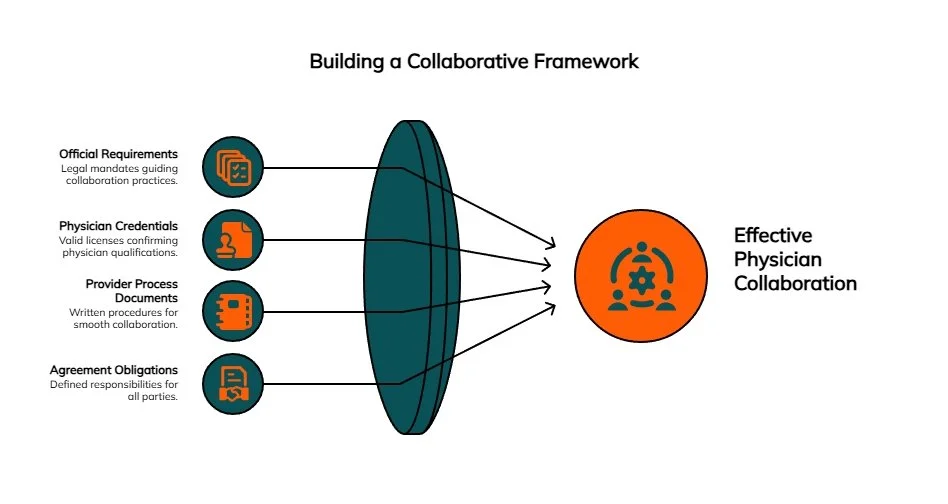
Evaluate four types of evidence separately:
Official requirements: Current statutes, regulations, board guidance, or other controlling sources.
Physician credentials: Current license and status records from the appropriate official authority.
Provider process documents: Written descriptions of onboarding, chart review, communication, escalation, and continuity.
Agreement obligations: The duties, limitations, and records assigned to the provider, physician, and practice.
Then apply a claim–proof–owner–record test:
Claim: What is being represented?
Proof: What document or official record supports it?
Owner: Which party is responsible for the related task?
Record: Where will completion or follow-up be documented?
For example, “We cover your state” should lead to a current license record, written service confirmation, a named owner for renewals or filings, and a recordkeeping location. Documentation does not establish legal sufficiency by itself, but it gives the practice and its advisors something concrete to review.
A signed agreement describes intended responsibilities. Review logs, communications, follow-up records, and renewal records help show whether the arrangement is functioning as described. Related concerns are discussed further in this guide to documentation gaps in NP–physician collaboration.
1. Verify state fit and physician eligibility
Identify every jurisdiction implicated by the practice model, then use a consistent verification sequence:
Map the states connected to the proposed services and arrangement.
Identify the relevant nursing board, medical board, statute, regulation, or other official authority.
Verify the physician’s current license and applicable status directly.
Compare the proposed arrangement with current official requirements.
Obtain qualified legal or compliance review where interpretation is needed.
Do not treat a provider’s state list as proof that a specific physician and arrangement fit your practice. Company-level service coverage, physician eligibility, and legal sufficiency are separate questions.
Licensure is an important threshold check, not a complete fit assessment. Ask who monitors renewals, restrictions, changes in status, and any required notifications. Avoid interpreting disciplinary or status information without qualified review. For example, while Florida requires a written protocol outlining specific delegated duties, California requires standardized procedures with distinct levels of physician availability.
Terminology also varies. “Collaborating physician” and “supervising physician” may not be interchangeable in every jurisdiction. Use the terms found in current official guidance.
Consider a small telehealth NP practice planning to enter another state. If the provider says it has coverage there, before relying on that statement, the practice should request current physician-license verification, written confirmation of the proposed service arrangement, and identification of the official sources used to assess it. The practice then obtains professional review of any unresolved legal question.
For broader planning, this multi-state telehealth collaboration framework can help organize questions, but it is not a substitute for current official authority.
2. Clarify documentation, responsibility, and service boundaries
A service boundary states what the provider will and will not do. A responsibility matrix assigns recurring tasks among the provider, physician, and practice without assuming that the allocation is legally sufficient.
Request a draft agreement or representative structure early enough for both legal and operational review. Counsel may assess legal sufficiency, while the owner, NP, administrator, and compliance lead should determine whether the workflows are realistic.
A useful responsibility matrix may include:
| Evaluation area | Questions to ask | Evidence to request | Escalate when |
|---|---|---|---|
| State and licensure fit | Which jurisdictions and circumstances were assessed? | Current license record and written service confirmation | The requirement or eligibility is unclear |
| Documentation | Which documents are supplied, updated, and retained? | Draft agreement and document inventory | A required item or retention duty may be involved |
| Responsibility allocation | Who owns each recurring task? | Written responsibility matrix | Duties are unassigned or disputed |
| Chart-review workflow | How are reviews selected, recorded, and followed up? | Written workflow and sample log | A state-specific method is asserted |
| Communication and escalation | Which channels, expectations, and pathways apply? | Written communication standards | “Access” remains undefined |
| Practice and specialty fit | Why does the physician and model fit the practice? | Physician profile and scope discussion | Suitability is asserted without explanation |
| Continuity and small-business fit | What happens during leave, termination, replacement, or expansion? | Onboarding checklist and continuity process | No transition plan exists or burden is unclear |
Measured warning signs include important answers remaining verbal, sales statements conflicting with agreement terms, recurring tasks having no owner, “physician access” remaining undefined, and no written transition process being available.
Professional review is appropriate when: the practice needs an interpretation of state law, agreement sufficiency, prescribing or telehealth requirements, physician eligibility, or whether a proposed workflow satisfies an official requirement.
Questions To Ask Before The Agreement Is Finalized
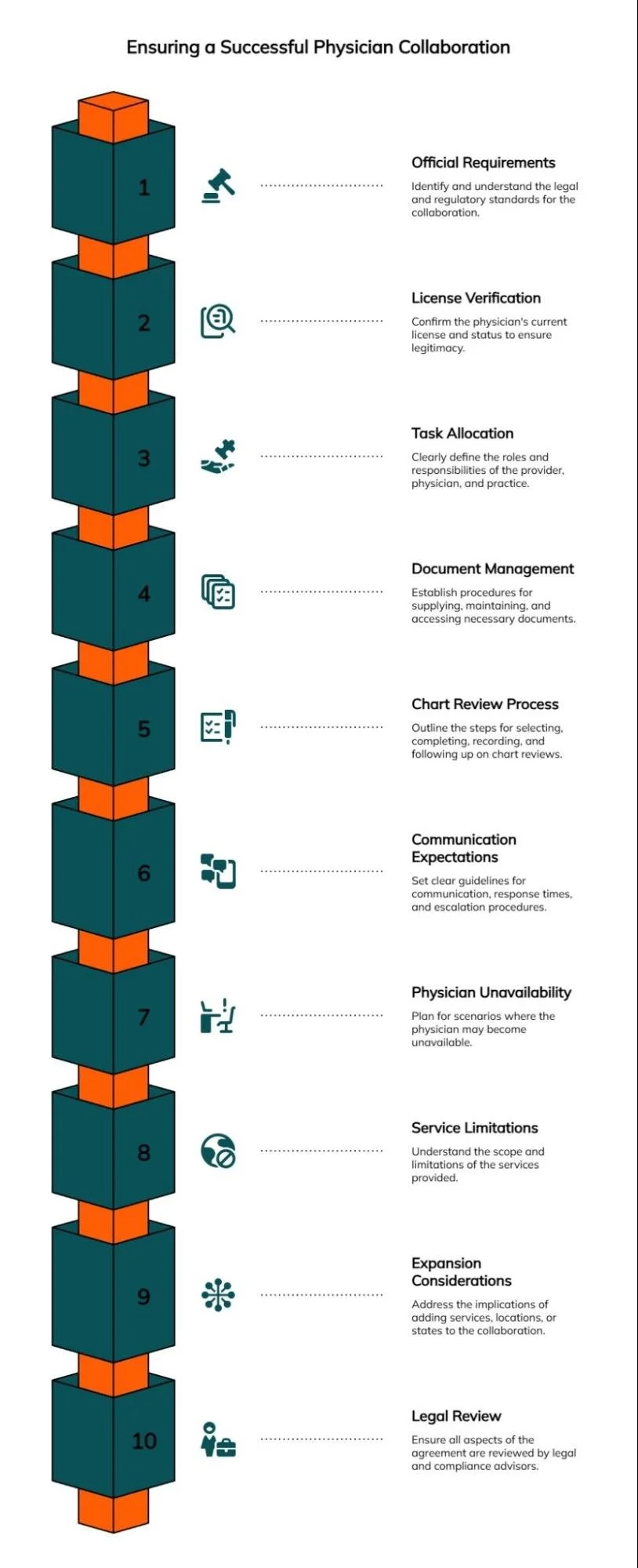
Which official requirements were used to assess the arrangement?
How can we independently verify the physician’s current license and status?
Which tasks belong to the provider, physician, and practice?
What documents will be supplied, maintained, and available to us?
How are chart reviews selected, completed, recorded, and followed up?
What communication, response, and escalation expectations will be written?
What happens if the physician becomes unavailable?
Which service limitations should we understand before signing?
What changes if we add a service, location, or state?
Which issues should our attorney or compliance advisor review?
Complete answers do not eliminate professional review. They make it more focused.
Frequently Asked Questions
Is physician licensure enough to confirm that collaboration support is a good fit?
No. Current licensure is an important verification step, but the practice should also assess state-specific requirements, service boundaries, documentation, communication, chart review, operational fit, and continuity. Verify a real physician’s status through the appropriate official authority and seek qualified review where eligibility or suitability requires interpretation.
Should a small NP practice choose the provider that can match it fastest?
Matching speed may matter, but it should be evaluated with state fit, physician eligibility, written responsibilities, workflow compatibility, administrative burden, and transition planning. A fast process may be workable when the required evidence and review are still completed.
Can a physician collaboration-support provider handle compliance for the practice?
A provider may perform defined administrative or coordination tasks, but the practice should not assume that every legal or compliance responsibility has transferred. The agreement and responsibility matrix should identify who handles each activity, and applicable requirements should be verified through current official authorities and qualified counsel.
Make The Decision Reviewable
A sound evaluation produces a reviewable record of what was checked, what was promised, who owns each task, and what still requires professional verification. That record can be shared with the owner, operations lead, counsel, and compliance reviewer so unresolved issues remain visible before the arrangement is relied upon. Use the scorecard to organize questions before reviewing a proposal or agreement, compare verbal statements with written terms, and confirm applicable requirements through current official sources.
To discuss your practice needs, request a free quote from Physician Collaborators.
Disclaimer: This article is for general informational purposes only and does not constitute legal, compliance, medical, safety, technical, or other professional advice. Requirements and appropriate practices may vary by jurisdiction, practice model, services, and individual circumstances. Confirm current requirements with the relevant licensing boards, regulatory authorities, and qualified legal or compliance professionals before making decisions for your practice.
Our Editorial Process:
Our expert team uses AI tools to help organize and structure our initial drafts. Every piece is then extensively rewritten, fact-checked, and enriched with first-hand insights and experiences by expert humans on our Insights Team to ensure accuracy and clarity.
About the Physician Collaborators Insights Team:
The Physician Collaborators Insights Team is our dedicated engine for synthesizing complex topics into clear, helpful guides. While our content is thoroughly reviewed for clarity and accuracy, it is for informational purposes and should not replace professional advice.