Opening an Independent NP Practice: Collaboration Compliance Questions to Answer Early
📌 Key Takeaways
The author recommends verifying collaboration rules and daily workflows before fixing services, prescribing plans, or launch dates.
Verify Rules First: Use current official sources and qualified reviewers because collaboration rules vary by jurisdiction and practice model.
Match Plans to Practice: The physician arrangement should fit every planned service, setting, patient location, and prescribing activity.
Make Terms Workable: A signed agreement is not enough without clear review, communication, escalation, recordkeeping, and ownership processes.
Keep Clear Evidence: Practices should record each answer, source, date, owner, follow-up date, and evidence location.
Review Every Major Change: New services, locations, prescribing plans, or physician changes should trigger a fresh review of the arrangement.
Verified answers turn paperwork into a launch-ready practice.
Independent NPs preparing to launch will spot compliance gaps early, using the detailed readiness checklist that follows.
~ ~ ~ ~ ~ ~ ~ ~ ~ ~ ~ ~ ~ ~ ~ ~ ~ ~
An independent NP practice can have a business plan, service menu, EHR, and intended opening date while still lacking a clear answer to one operational question: How will physician collaboration work in practice? Requirements vary by jurisdiction and practice circumstances, and a signed agreement alone should not be treated as the entire readiness process. For example, one state may require a 10% monthly chart review across all patients, while a neighboring state requires review only for prescribed controlled substances. Before finalizing services, prescribing plans, workflows, or launch dates, resolve questions about jurisdiction, clinical scope, physician eligibility, agreement terms, daily processes, records, and continuity. This article offers an issue-spotting and verification framework, not a legal determination. Its purpose is to help you separate assumptions from verified answers, assign each question to the right reviewer, and retain evidence of how the answer was reached.
Start With the Jurisdiction and Practice Model
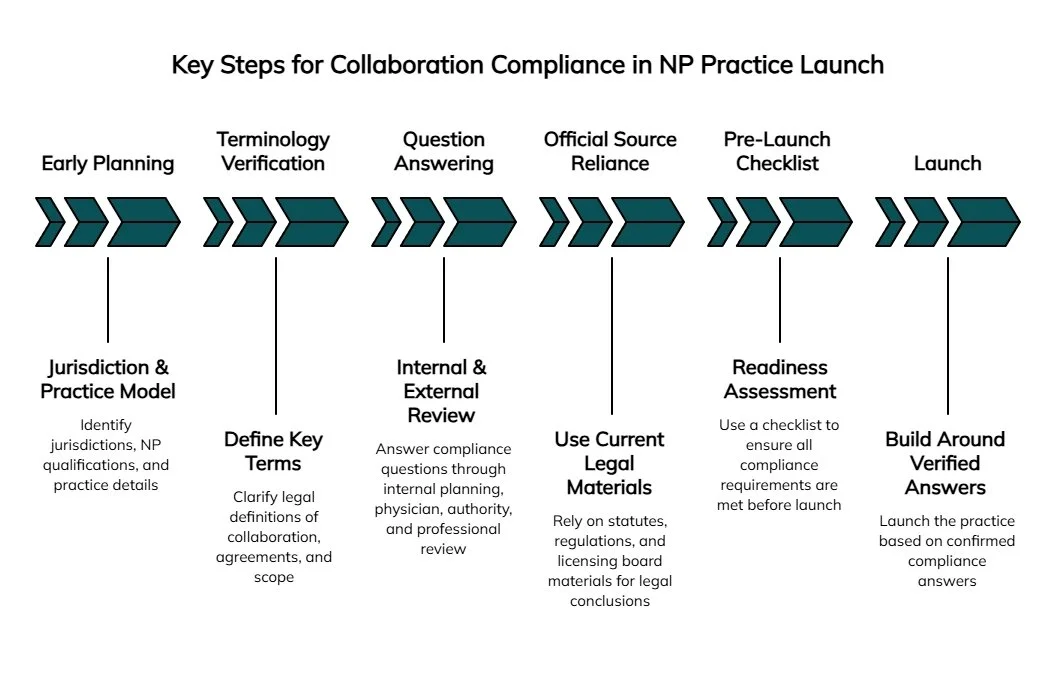
Begin by identifying every jurisdiction connected to the planned care model. Then confirm the NP’s license, certification, experience, ownership structure, practice setting, services, patient population, and prescribing plans where relevant. These factors form an issue-spotting framework; they do not mean every factor changes the rule in every jurisdiction.
Terminology also needs verification. A collaborating physician or supervising physician may describe a legally defined relationship, but the terms are not automatically interchangeable. A collaborative practice agreement is a written arrangement whose required form and content may vary. A medical director, consultation arrangement, or practice protocol may describe a different role or document and should not be assumed to satisfy the same requirement. Scope of practice concerns the professional activities an NP may perform, while prescriptive authority concerns the authority to prescribe. Chart review means a defined process for reviewing selected patient records. A review trigger is a change that prompts the practice to reassess the arrangement; it is not automatically a legal violation.
For each major question, decide which of four answer paths applies:
Internal planning: What services, patients, locations, systems, and opening dates are proposed?
Prospective physician: Can the physician perform the expected role and support the planned workflow?
Official authority: What do current statutes, regulations, and licensing-board materials require?
Professional or organization-specific review: What must an attorney, compliance professional, insurer, payer, credentialing body, facility, pharmacy, or technology provider confirm?
Do not rely on:
A colleague’s arrangement
A generic or “standard” contract template
A vendor’s marketing page
An outdated summary
The assumption that every jurisdiction uses the same terminology
Use current official sources for any legal conclusion. Further reading on how location affects collaboration requirements can help organize questions, but it is not a substitute for official authority.
Match the Arrangement to the Services You Plan to Provide
Describe the practice as it will actually operate. List every planned service, patient population, care setting, delivery method, prescribing activity, and jurisdiction. The physician relationship should be evaluated against that complete model, not against a generic description of an NP practice.
Ask whether physician license status, eligibility, specialty relationship, availability, location, or scope must be verified for the proposed role. Do not assume that a physician’s license alone resolves suitability, or that every service legally requires a different specialty. Separate legal eligibility from operational fit.
Prescribing decisions belong in pre-launch planning. Determine whether the practice expects to prescribe, whether controlled substances are contemplated, and which state and federal authorities must answer the resulting questions. Do not insert a threshold, registration step, form, or deadline unless the current official requirement has been verified.
Consider three hypothetical changes:
A primary-care practice expects to add behavioral health. That should prompt questions about physician fit, consultation access, agreement scope, and workflow.
A telehealth practice plans to treat patients in another state. Do not assume the office location answers every jurisdictional question or that one arrangement covers every location.
An NP plans to begin controlled-substance prescribing after launch. Waiting may leave agreement, registration, communication, and technology decisions unresolved.
Disclose reasonably anticipated services before finalizing the arrangement. A late change can affect several workstreams at once, including agreement review, credentialing, EHR configuration, pharmacy processes, staff training, and the opening timeline.
Turn the Agreement Into Workable Review and Communication Processes
A written arrangement should connect to an executable process. Ask how roles, responsibilities, physician availability, consultation, escalation, chart review, amendments, renewals, and document control will work day to day. Questions about collaboration agreement terms to review before signing can support preparation, but exact requirements need current official support and qualified review.
A clearly labeled hypothetical workflow might be:
Charts are selected under the verified requirement or agreed process.
The review is recorded in the designated system.
Feedback and follow-up tasks are assigned.
Completion evidence is retained.
A named owner monitors recurring responsibilities.
Do not add an assumed sampling percentage, meeting cadence, deadline, or retention period. If a physician says a template is standard, ask which current authority supports its use for this practice and obtain appropriate agreement review.
Technology does not replace process design. If the practice plans to track reviews or consultations in email, ask whether that method supports the verified workflow, privacy and security needs, access, retention, responsibility, and evidence requirements. The agreement, internal policy, staff instructions, EHR, messaging tools, and storage system should tell the same operational story. Staff training may be prudent even when no separate training mandate has been established.
Consider a hypothetical practice whose agreement mentions chart review but whose staff do not know how charts are selected, where feedback is recorded, or who closes follow-up tasks. The missing issue is not another clause alone; it is an owned process. Further guidance on preparing chart-review and physician-communication workflows may help frame implementation questions.
Plan for Documentation, Coverage, and Future Change
Define one reliable evidence trail. Identify where the current agreement, amendments, licenses, review records, material consultation records, renewal evidence, and related policies will be stored. Avoid the vague instruction to “document everything.” Specify which records matter, who maintains them, where they are kept, and how authorized users retrieve them.
Assign responsibility for expiration monitoring, renewals, amendments, and unresolved follow-up. A useful readiness record contains the question, working answer, source, date checked, owner, follow-up date, and evidence location. Reviewing documentation gaps that can complicate collaboration can support internal planning, but mandatory retention rules still require official verification.
Plan for physician leave, nonresponse, loss of eligibility, termination, or practice closure. A hypothetical temporary absence should prompt questions about affected services, available coverage, required notices, record access, and whether a pause is necessary. Do not assume a universal grace period or substitute arrangement.
Create an internal pause-and-review process for these planning triggers:
A new jurisdiction or patient location
A new service line or patient population
Beginning or materially changing prescribing
Adding controlled substances (including confirming whether the collaborating physician must hold an active DEA registration in the specific state where the NP is prescribing)
Moving between in-person and telehealth care
A different collaborating physician
Material chart-review or communication changes
Ownership, facility, payer, credentialing, or insurance changes
Physician absence, termination, or eligibility change
These are reasons to reassess, not automatic findings that the agreement is invalid.
Use a Pre-Launch Collaboration Readiness Checklist
Caution: Completing this checklist does not establish compliance. It helps identify missing decisions, verification needs, and operational work.
| Question to Resolve | Why It Matters | Who Should Verify | Evidence or Record to Keep | Status |
|---|---|---|---|---|
| Which jurisdiction and authority apply? | Sets the research path | Official sources; counsel as needed | Source, date, jurisdiction | |
| What relationship is required, if any? | Answers the threshold question | Boards, statutes, qualified reviewer | Verified answer and open issues | |
| Is the physician eligible for the role? | License may not answer every condition | Nursing/medical boards; counsel | License and eligibility record | |
| Does the arrangement fit all services and settings? | Connects the agreement to operations | NP, physician, reviewer | Final service and setting list | |
| Are prescribing and controlled-substance questions resolved? | May affect several launch decisions | State/federal authorities | Current source and decision record | |
| Does the agreement address verified requirements and responsibilities? | Reduces ambiguity | Attorney or compliance reviewer | Executed agreement and review notes | |
| Are review, consultation, communication, and escalation executable? | Turns terms into routine work | NP, physician, operations owner | Workflow and training record | |
| Is documentation and retention defined? | Creates an accessible evidence trail | Compliance and records owners | Storage map and retention guidance | |
| Are absence, replacement, termination, and transition addressed? | Supports continuity | Physician, counsel, relevant bodies | Coverage or transition plan | |
| Are telehealth and patient-location questions resolved? | Geography may change the analysis | Relevant official authorities | Jurisdiction map and sources | |
| Are renewal and change-review duties assigned? | Prevents ownership gaps | Practice owner or compliance lead | Calendar, owner, triggers | |
| Is each answer supported by a current source or qualified review? | Separates assumptions from verified answers | Assigned verifier | Source, date, owner, evidence location |
Use status labels such as Verified, Needs professional review, Waiting on official guidance, Internal workflow incomplete, or Not applicable—with reason. Do not convert the checklist into a compliant/not-compliant score.
Know Who Should Verify Each Answer
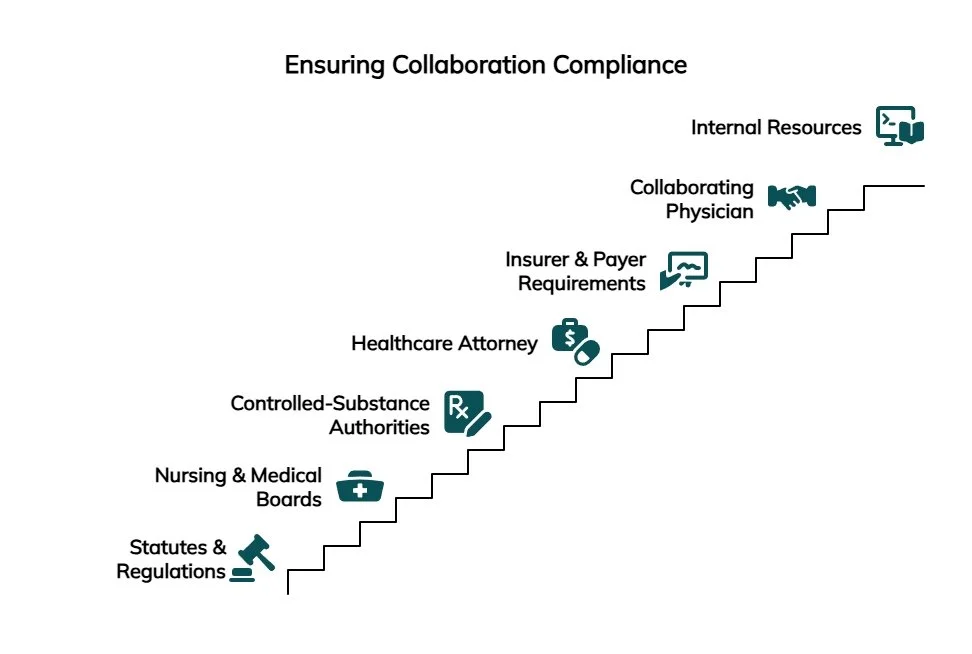
Who verifies what?
Current statutes, regulations, and official agency guidance: Legal and procedural requirements.
State nursing and medical boards: Licensing, professional-role, and board-specific questions.
Federal or state controlled-substance authorities: Relevant prescribing, registration, or monitoring questions.
Qualified healthcare attorney or compliance professional: Practice-specific interpretation and agreement review.
Insurer, payer, credentialing entity, facility, pharmacy, or technology provider: Their own coverage, participation, access, documentation, or system requirements.
Prospective collaborating physician: Operational fit, availability, responsibilities, and communication expectations.
Internal articles and vendor resources: Education and question development only.
No single source answers every question. For each material answer, record the question, answer, source, date checked, owner, follow-up date, and evidence location. Peer experience can provide context, but it should not control a different practice’s decision.
Frequently Asked Questions
Do all independent NPs need a collaborating physician?
There is no universal answer. Requirements may depend on the jurisdiction, the NP’s status, services, practice setting, prescribing plans, and other circumstances. Confirm the current rule through applicable statutes, regulations, licensing boards, and qualified professional review.
Is a signed collaboration agreement enough before opening?
A signed agreement should not be treated as the complete readiness process. The practice also needs executable responsibilities, communication and review workflows, records, renewal ownership, continuity planning, and verification that the arrangement fits current requirements and the proposed practice.
When should an NP practice review the arrangement again?
Review it when services, prescribing, patient geography, care setting, physician relationships, ownership, credentialing conditions, insurance requirements, or operating workflows change. A new rule, license condition, agreement amendment, or eligibility issue may also warrant reassessment.
Who should confirm state-specific requirements?
Start with current statutes, administrative rules, and official nursing or medical-board guidance. Depending on the question, also consult a qualified healthcare attorney, compliance professional, insurer, payer, credentialing organization, facility, pharmacy, or other relevant authority.
Build the Launch Around Verified Answers
Do not measure readiness only by whether a physician has been identified. Resolve, assign, verify, and document the material questions, then revisit the arrangement as the practice changes. Complete the checklist before locking the opening date or final workflows, and treat unresolved regulatory questions as blocking until the appropriate authority or qualified professional addresses them. If timing is tight, prioritize threshold requirements, physician eligibility, prescribing, and issues that could change the planned services.
When discussing the practice with a prospective physician or support provider, bring the verified service plan, jurisdictions, prescribing decisions, workflow expectations, source records, and unresolved questions. Physician Collaborators offers collaboration support for independent practices; readers who have completed that preparation may Get a Free Quote. Requesting a quote does not replace legal, licensing, credentialing, insurance, or compliance review.
Disclaimer: This article is for general informational purposes only and does not constitute legal, compliance, medical, or other professional advice. Collaboration and practice requirements vary by jurisdiction and individual circumstances and can change. Verify current requirements through the relevant licensing boards, statutes, regulations, and other official authorities, and consult qualified legal or compliance professionals regarding your specific practice.
Our Editorial Process:
Our expert team uses AI tools to help organize and structure our initial drafts. Every piece is then extensively rewritten, fact-checked, and enriched with first-hand insights and experiences by expert humans on our Insights Team to ensure accuracy and clarity.
About the Physician Collaborators Insights Team:
The Physician Collaborators Insights Team is our dedicated engine for synthesizing complex topics into clear, helpful guides. While our content is thoroughly reviewed for clarity and accuracy, it is for informational purposes and should not replace professional advice. This guide is intended as a comprehensive starting professional.