Questions to Ask a Physician Collaboration Service About State Verification and Documentation
📌 Key Takeaways
The author recommends judging physician collaboration services by their evidence, clear task ownership, review schedule, and plans for change.
Demand Process Proof: Ask what the provider checks, which official sources it uses, what records you receive, and when reviews repeat.
Check More Than Licenses: An active license alone does not prove physician eligibility; request dated checks covering role fit and relevant limits.
Assign Every Task: Get a written matrix naming who prepares, reviews, signs, files, stores, updates, and retrieves each record.
Recheck After Changes: The author recommends scheduled checks after new services, states, license changes, amendments, or physician replacement.
Plan for Disruptions: The author recommends a written transition plan for physician unavailability, eligibility problems, termination, and continued record access.
Clear proof beats broad compliance promises.
Nurse practitioner practices comparing physician collaboration services will spot weak processes faster using the provider questions and scorecard below.
~ ~ ~ ~ ~ ~ ~ ~ ~ ~ ~ ~ ~ ~ ~ ~ ~ ~
When evaluating a physician collaboration service, broad claims about supporting compliance are not enough. You need to know exactly what is verified, which authorities are consulted, what records are supplied, and which responsibilities remain with your practice.
If you are preparing for a provider call or comparing proposals, ask for more than a broad assurance. You need a clear description of the provider’s process and supporting documentation—the records that show what was reviewed, completed, or updated.
The questions and scorecard below can help a nurse practitioner (NP) practice evaluate that process. The same general framework may also be useful to physician assistant practices where it fits their particular arrangement. It is an evaluation tool, not a substitute for state-specific legal or compliance guidance.
Start With Four Things Every Provider Should Be Able To Explain
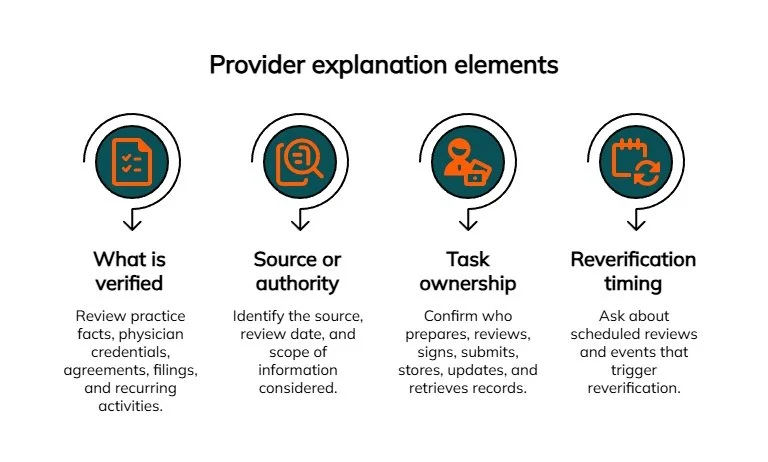
Use these four elements as a quick-reference screen:
What is verified? Ask which practice facts, physician credentials, agreements, filings, and recurring activities the provider reviews.
Which source or authority is used? The answer should identify the source, review date, and scope of the information considered.
Who owns the task and its records? Confirm who prepares, reviews, signs, submits, stores, updates, and retrieves each item.
When is the information checked again? Ask about scheduled reviews and events that trigger reverification.
Reverification involves reassessing previously reviewed information to account for the passage of time or intervening events. A clear process should identify its inputs, evidence, ownership, update cadence, and limitations.
These four elements do not establish that a process is legally sufficient in every jurisdiction. They help you determine whether a provider can explain its work in a way your practice can investigate.
Questions About State Verification
State verification is the process of identifying which state-related requirements may affect a particular practice and documenting the basis for that assessment. The process may depend on the practice’s services, locations, professional licenses, prescribing activities, patient locations, and operating model.
Ask the provider:
How do you determine which state requirements may apply to our practice?
Do you use a documented checklist, attorney review, state-board guidance, or another method?
Which official sources or authorities do you consult?
When were those sources last reviewed?
How do you account for patient location, practice location, professional licensure, and prescribing activity in a multi-state telehealth model?
Will you provide a written summary of the issues you evaluated?
What assumptions or limitations are included in that summary?
Which conclusions should our practice confirm with a licensing board, attorney, or compliance professional?
What happens when we add a service, location, prescriptive function, or state?
A useful answer should identify the methodology, named information sources, date of review, scope, assumptions, assigned owner, and escalation process. It should also distinguish information gathering from legal interpretation.
Consider a hypothetical NP-owned telehealth practice preparing to serve patients in a second state. The provider should be able to explain what must be reassessed, whether physician eligibility needs another review, whether the practice agreement and supporting documents need attention, and who will resolve unanswered questions.
An educational overview of restricted and reduced practice states may help frame the issue, but it is not a substitute for current state authority or qualified professional review.
Questions About Physician License And Eligibility Checks
An active physician license may be one part of an eligibility assessment, but it should not be treated as complete proof that the physician fits every collaboration arrangement.
Ask:
Which official license databases or board records do you check?
Do you confirm active license status in every relevant state?
Do you review restrictions, disciplinary information, or other limitations where relevant?
How do you assess whether the physician’s credentials and proposed role fit the practice?
Which additional eligibility factors do you evaluate beyond license status?
When is the initial verification performed?
Can our practice receive a dated record of the check?
What scheduled reviews or events trigger reverification?
Who decides whether new information affects the relationship?
A clear response should separate license status from broader physician eligibility. It should also identify what the provider verifies, what the practice must confirm, and which conclusions require professional review.
Request a dated verification record showing the source consulted, the date accessed, the scope of the review, and the person or function responsible. A screenshot or license lookup may be useful supporting documentation, but it should not be presented as proof of complete eligibility by itself.
Questions About Agreements, Supporting Records, And Record Retention
A signed agreement is only one component of a documented collaboration workflow. Your practice should understand which records exist, who controls them, how amendments are tracked, and whether the records remain accessible if the service ends.
Ask:
Who prepares the collaboration or supervision agreement?
Who reviews it for practice-specific and state-specific issues?
Who signs, files, submits, and retains each document?
Which documents will our practice receive?
Are versions, dates, signatures, and amendments tracked?
How are chart reviews, communications, meetings, and feedback documented?
Can the practice export or retrieve its records if the service ends?
How are missing records or document corrections handled?
What record-retention schedule is followed, and who verified it?
Ask for a sample document list, blank template, or redacted process description rather than another client’s confidential records.
A provider should also be able to explain its audit trail. In this context, an audit trail is a chronological record showing what was checked, completed, changed, or approved, by whom, and when. It may include dated verification records, document versions, signatures, review logs, notices, and amendment history.
A written responsibility matrix can prevent ownership gaps. It should identify each task and leave space to record the actual assignment, for example:
Provider: What does the service prepare, coordinate, monitor, or store?
Physician: What must the physician review, sign, complete, or communicate?
Practice: What information, filings, copies, or follow-up remain with the practice?
External reviewer: Which unresolved issues require confirmation by an attorney, compliance professional, board, or other authority?
This example does not assign legal responsibility. It shows how to document the provider’s proposed division of work. Hiring a service does not automatically transfer every professional, legal, operational, or compliance obligation away from the practice.
Related guidance on documentation gaps in NP–physician collaboration can help you prepare follow-up questions. Confirm any specific filing, document, or retention requirement through an appropriate official source or qualified professional.
Questions About Ongoing Monitoring And Regulatory Changes
Verification should not end after onboarding. Credentials, services, agreements, and operating circumstances can change.
Ask:
How often are physician licenses and relevant credentials rechecked?
Which reviews occur on a schedule?
Which events trigger an additional review? (For example, if a collaborating physician changes their primary state of residence or drops a specific hospital affiliation, how quickly is that flagged?)
How do you monitor expirations, restrictions, or other status changes?
How do you identify regulatory changes that may affect the arrangement?
Who determines whether an agreement or workflow needs revision?
How are clients notified?
How quickly can the practice access updated documentation?
What happens if the physician becomes unavailable or ineligible?
Is there a documented replacement and transition process?
Do not expect one universal review interval to fit every state or practice. Ask the provider to explain its cadence, trigger events, notification workflow, supporting records, and continuity plan.
In a hypothetical example, a physician’s license is approaching expiration. A transparent process should identify who detects the date, who confirms renewal, what record the practice receives, and what continuity or replacement step begins if the issue is not resolved.
The fastest available match may not be the best fit for a practice that cannot obtain clear answers about eligibility, documentation, ownership, or continuity. Speed can be one evaluation factor, but it should not replace due diligence.
Questions About Communication, Chart Review, And Issue Handling
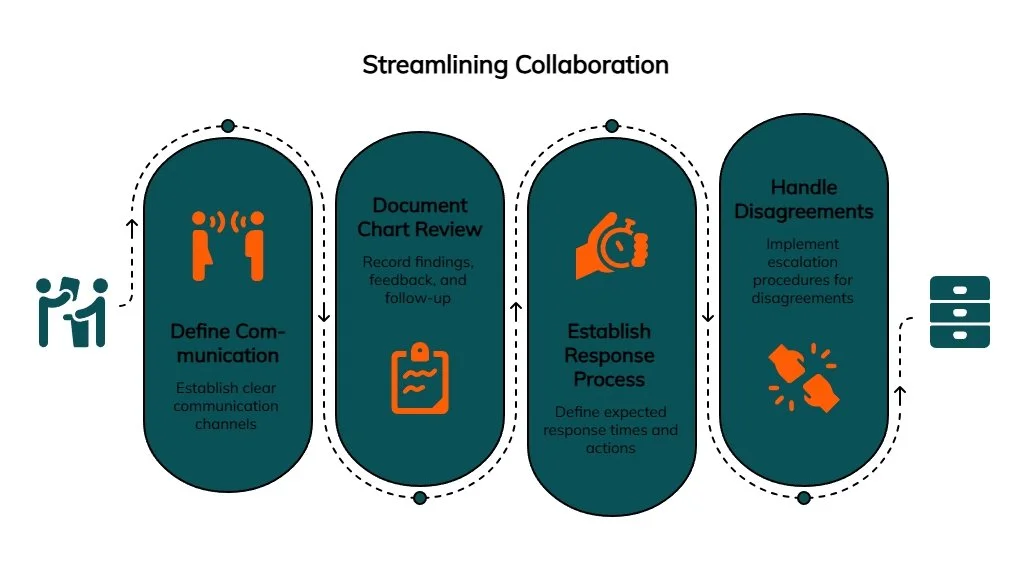
Recurring collaboration activities also need defined communication, documentation, and escalation procedures.
Ask:
Which communication channels are used?
How are clinically or operationally important communications recorded?
How are chart selections, reviews, findings, feedback, and follow-up documented?
What response process are the parties expected to follow?
What happens when the NP and physician disagree?
How are missed reviews or delayed responses escalated?
Which information belongs in the clinical record, and which belongs in an administrative collaboration log?
Who can access those records, and how are they retrieved?
Do not assume a universal communication frequency, chart-review percentage, or response time. Ask the provider to describe the workflow, the record created at each step, and the escalation path.
For additional preparation questions, review chart-review and physician-communication expectations.
Compare Providers With A Verification And Documentation Scorecard
Record each answer using one of three statuses:
Clear and documented
Partially clear or requires follow-up
Unclear or unsupported
| Evaluation area | Question to ask | Evidence or record requested | Responsible party | Review or update cadence | Follow-up needed? |
|---|---|---|---|---|---|
| State-rule identification | How do you identify the requirements that may apply? | Dated source list, methodology, and written scope | Record who reviews and who confirms | Ask when sources are reviewed again | Status and unresolved questions |
| Physician license and eligibility | What do you verify beyond active license status? | Dated verification record | Record provider, practice, physician, and reviewer roles | Ask about scheduled and triggered checks | Status and unresolved questions |
| Agreement preparation and execution | Who prepares, reviews, signs, and updates each agreement? | Document inventory or responsibility matrix | Record each party’s task | Ask when amendments are reconsidered | Status and unresolved questions |
| Filing or submission responsibilities | Who identifies and completes any required submission? | Process description and completion record | Record who prepares, submits, and confirms | Ask what triggers a new review | Status and unresolved questions |
| Chart-review and communication records | How are recurring activities documented and escalated? | Blank log, workflow, or sample template | Record physician, NP, practice, and provider roles | Ask how missed items are tracked | Status and unresolved questions |
| Renewal and change monitoring | How are expirations and relevant changes identified? | Monitoring, notice, and updated-record procedure | Record who monitors and who decides | Ask for cadence and trigger events | Status and unresolved questions |
| Physician replacement or termination | What happens if the relationship ends or the physician is unavailable? | Transition and record-access procedure | Record continuity and notification owners | Ask when the plan is activated | Status and unresolved questions |
Reasons for further inquiry include:
Broad compliance assurances without process detail
No named source, methodology, or review date
Unclear responsibility for filing or record retention
No accessible verification record or audit trail
No stated reverification cadence
No plan for physician unavailability
Reluctance to identify limitations or outside-review needs
Excessive emphasis on speed without comparable process detail
These signals do not prove wrongdoing. They identify areas that require clarification, documentation, or professional review.
When a provider says, “We handle compliance,” respond with four questions: What exactly do you verify? Which source do you use? What record do we receive? When is it checked again?
Frequently Asked Questions
Is a provider’s state-verification process the same as legal advice?
No. A provider may gather information, explain its process, or support documentation, but the practice should clarify whether legal interpretation is included. Experience in a state does not replace advice about the practice’s particular circumstances. Confirm important state-specific decisions with the relevant authority or a qualified professional.
Should the provider or the NP practice maintain collaboration documents?
The answer may depend on the document, agreement, state, and service arrangement. Obtain a written responsibility matrix showing who creates, reviews, signs, files, stores, updates, and can retrieve each record.
How often should physician credentials and state requirements be rechecked?
There is no universal interval presented here. Ask about scheduled reviews and trigger events such as license renewal, disciplinary changes, service expansion, new states, agreement amendments, or physician replacement.
Use Process Clarity To Guide The Next Conversation
A strong evaluation focuses on transparency, supporting documentation, responsibility, update cadence, accessible records, and the provider’s willingness to acknowledge limitations. Use the scorecard during provider conversations, record unanswered questions, and obtain qualified review for issues that depend on a particular jurisdiction or practice structure.
Use the checklist to document your questions. To discuss service fit with Physician Collaborators, request a free quote.
Disclaimer: This article is for general informational purposes only and does not constitute legal, compliance, regulatory, medical, or other professional advice. Physician collaboration requirements, documentation duties, and professional-practice rules may vary by state, practice, service, and individual circumstances and may change over time. Confirm important decisions with the relevant licensing board, regulatory authority, qualified healthcare attorney, or compliance professional.
Our Editorial Process:
Our expert team uses AI tools to help organize and structure our initial drafts. Every piece is then extensively rewritten, fact-checked, and enriched with first-hand insights and experiences by expert humans on our Insights Team to ensure accuracy and clarity.
About the Physician Collaborators Insights Team:
The Physician Collaborators Insights Team is our dedicated engine for synthesizing complex topics into clear, helpful guides. While our content is thoroughly reviewed for clarity and accuracy, it is for informational purposes and should not replace professional advice. This guide is intended as a comprehensive starting professional.