How Independent NP Practices Can Evaluate Physician Collaboration Providers for Compliance Fit
📌 Key Takeaways
The guide recommends choosing physician collaboration providers by verifying jurisdiction fit, workflows, duties, costs, and transition plans—not speed alone.
Verify Every Jurisdiction: The guide recommends confirming physician licenses, duties, and required documents through current official sources for each jurisdiction.
Demand Written Workflows: The guide recommends getting clear chart-review, communication, escalation, backup, and record storage steps before accepting service promises.
Assign Every Responsibility: The guide recommends assigning clear duties and limits to the provider, physician, practice, counsel, and other advisors.
Plan For Disruption: The guide recommends written replacement, switching, termination, and record-access terms to protect continuity when physicians become unavailable.
Compare Evidence, Not Claims: A scorecard should track dated documents, missing proof, service limits, exclusions, and questions needing professional review.
Choose the process you can verify, not the promise.
Independent NP practice owners will compare collaboration providers more confidently, preparing them for the detailed scorecard that follows.
~ ~ ~ ~ ~ ~ ~ ~ ~ ~ ~ ~ ~ ~ ~ ~ ~ ~
A practical evaluation guide for independent nurse practitioner practices
Two physician collaboration providers may both say they can support your practice yet offer different agreement assistance, chart-review processes, physician access, and transition terms. During a launch, renewal, or physician departure, time pressure can make those differences harder to compare because packages use different names and service language.
A useful evaluation looks beyond price, matching speed, and physician availability. It asks whether the provider can document state verification, define responsibilities, explain ongoing workflows, demonstrate physician fit, and manage change. The seven criteria below lead to a scorecard for comparing proposals using the same evidence.
Start With Compliance Fit, Not Just Price, Speed, or Physician Availability
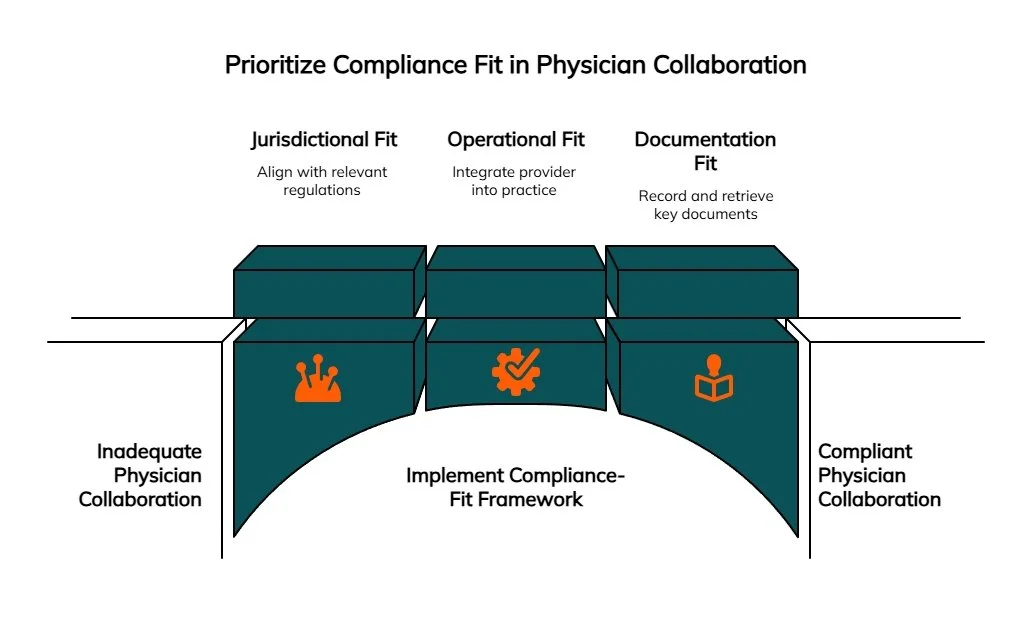
For this evaluation, compliance fit means alignment among three elements of the proposed arrangement:
| Jurisdictional fit | Operational fit | Documentation fit |
|---|---|---|
|
The physician, practice activities, and arrangement can be evaluated against the current requirements that apply to each relevant jurisdiction.
For example, New Jersey requires specific prescribing protocols, New York mandates Form 4NP for newer NPs, and Pennsylvania demands written collaborative agreements—each with distinct oversight proof requirements. |
The provider’s communication, chart-review, escalation, and support processes work within the practice’s day-to-day model. | Responsibilities, agreements, reviews, changes, and communications can be recorded and retrieved when needed. |
This is a purchasing framework, not a legal standard or compliance certification. A feature may support a workflow without proving legal sufficiency.
Vendor-owned evidence means the provider’s contracts, FAQs, credential records, and workflow documents. It can show what the provider says it supplies, but not the governing rule. Compare the same functions across providers, then verify requirements through current official sources and qualified professional review.
Seven Criteria for Comparing Physician Collaboration Providers
1. State Coverage and Physician-License Verification
Ask which jurisdictions the provider currently supports and which physician would be proposed for your practice. Request the physician’s identifying and license information, then ask how the provider confirms active status, eligibility for the proposed role, and any other jurisdiction-specific qualifications. Find out whether credentials are rechecked and how the practice is notified of a change.
For a multi-state practice, request a state-by-state map identifying the proposed physician, relevant documents, and each party’s responsibilities. Independently confirm current rules through the appropriate state boards and official authorities. A provider’s coverage statement is a starting point, not regulatory verification.
Hypothetical example: A single-state primary care practice receives two proposals. One includes the physician’s license information, a written chart-review process, and a responsibility matrix; the other offers only verbal assurance of coverage. The first is easier to verify, but current requirements still need independent confirmation.
Hypothetical example: A telehealth practice adding two states asks each provider to map the physician, credentials, documents, review workflow, and retained practice duties to each jurisdiction. A general coverage claim cannot answer those operating questions.
2. Agreement and Documentation Support
Determine exactly what the provider prepares, reviews, signs, stores, or leaves to the practice and its counsel. Ask whether templates are tailored by jurisdiction, who arranges legal review, and who is responsible for amendments, renewals, filings, notices, and updates when applicable requirements or the practice model changes.
Request a responsibility matrix covering the agreement, credential records, chart-review documentation, communication records, renewals, and transitions. Confirm how the practice receives copies and audit trails. A signed document does not establish that every ongoing obligation has been addressed.
Review documentation gaps that can complicate collaboration and agreement clauses to examine before signing as separate preparation steps, not substitutes for legal review.
3. Chart-Review and Oversight Workflow
Translate terms such as “oversight” or “chart review” into a repeatable process. Ask how charts are selected, how often reviews occur, who initiates them, where findings are recorded, how feedback reaches the NP, and how unresolved items are tracked. Request sample logs or reports with protected information removed, if available.
The process may need to change with jurisdiction, specialty, practice activity, or risk profile. The Physician Collaborators FAQ, for example, describes a monthly review of a sample of charts. That is a provider-specific service description, not a universal legal standard.
Compare chart-review and physician-communication expectations against your practice’s requirements before accepting a package description.
4. Communication, Availability, and Escalation Standards
Convert informal promises of physician access into written operating expectations. Identify permitted communication channels, routine availability, expected response windows, the distinction between routine and urgent issues, the escalation path, and backup coverage. Clarify how clinical and administrative communications are documented and retained.
A provider may list text, email, phone, or scheduled video conferences, as the Physician Collaborators FAQ does. The channel alone does not establish that privacy, security, recordkeeping, or response requirements are satisfied.
Ask who is responsible for configuring and monitoring each system, what information may be exchanged, and what happens when the usual physician cannot respond.
5. Specialty and Practice-Model Alignment
Separate legal eligibility from operational suitability. Ask about the physician’s familiarity with your specialty, patient population, care setting, prescribing activities, procedures, and telehealth footprint. Define the support intensity your team needs, from hands-on guidance to less-involved administrative oversight, and discuss how the physician approaches questions, feedback, and review.
Hypothetical example: A behavioral health NP compares a generalist physician with a physician familiar with the practice’s patient population, medications, communication needs, and review workflow. The second profile may be a stronger operational fit, but specialty familiarity does not establish a legal requirement or guarantee outcomes. Verify regulatory eligibility separately.
6. Onboarding, Physician Replacement, and Termination
Review the full service lifecycle before signing. Ask for the onboarding sequence, required documents, activation dependencies, and the point at which the arrangement becomes active.
If the physician becomes unavailable, request the notice process, replacement timeline, interim responsibilities, and backup arrangements. Re-evaluate the service when adding a jurisdiction, service line, prescribing activity, or material change to the telehealth or clinical model.
The agreement should also address termination rights, record access after termination, final documentation, outstanding reviews, and any charges or restrictions connected with a switch. Physician Collaborators states that clients may switch physicians, but the applicable conditions should be confirmed in the current agreement. Transition terms are most useful when settled before a disruption occurs.
7. Service Scope, Technology, and Pricing Transparency
Compare the actual package rather than the headline fee. Request a written service scope showing what is included, what is limited, and what costs extra.
Review added-state or added-provider charges, chart-review limits, communication limits, agreement support, record storage, technology requirements, renewal terms, termination charges, price-change provisions, and support outside regular business hours. Additionally, confirm whether the vendor provides malpractice coverage for the collaborating physician or if your practice must supply it. If the provider supplies it, explicitly ask who holds financial responsibility for 'tail coverage' once the physician departs
Do not assume that a lower fee means weaker support or that a higher fee proves better compliance fit. The practical question is whether the quote covers the functions your practice needs and clearly assigns the work that remains with the practice, physician, provider, counsel, or another advisor. Record exclusions and unresolved items beside the price.
Use a Compliance-Fit Scorecard to Compare Providers Consistently
Record whether requested evidence was received, not merely whether a representative answered “yes.” Useful status labels are:
Confirmed
Partially confirmed
Not confirmed
Requires professional review
Note the document received, its date, and any condition that still needs verification.
Physician Collaboration Provider Comparison Scorecard
| Criterion | What to Ask | Evidence to Request | Provider A | Provider B | Follow-Up Needed |
|---|---|---|---|---|---|
| State coverage and licensure | Who is proposed for each jurisdiction, and how are credentials rechecked? | License details, verification process, and state-by-state map | |||
| Agreement and documentation | Who prepares, updates, files, stores, and reviews each document? | Draft agreement, responsibility matrix, and records policy | |||
| Chart-review workflow | How are charts selected, reviewed, documented, and followed up? | Workflow, sample log, and reporting format | |||
| Communication and escalation | Which channels, response expectations, backups, and escalation steps apply? | Written protocol, contact plan, and recordkeeping process | |||
| Specialty and practice fit | What experience and support intensity fit this practice model? | Physician profile and service-scope explanation | |||
| Onboarding and transitions | What happens at activation, replacement, switching, and termination? | Onboarding plan and replacement and termination terms | |||
| Scope, technology, and price | What is included, limited, excluded, or separately charged? | Current quote, contract, fee schedule, and technology terms |
The scorecard organizes due diligence; it does not determine legal sufficiency or replace official verification and professional advice.
Red Flags That Warrant Follow-Up Before Signing
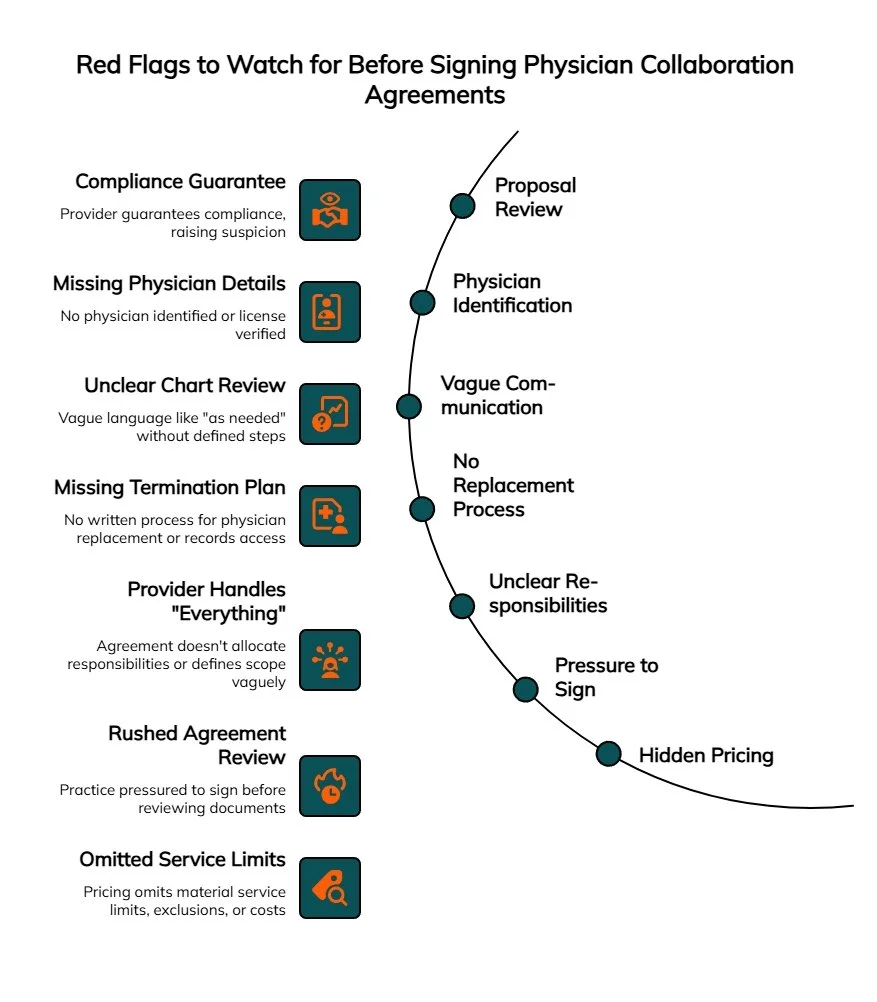
A red flag is an unresolved due-diligence question, not proof that a provider has acted unlawfully. Pause for clarification when a proposal includes:
A guarantee that the service will make or keep the practice compliant.
No identification of the proposed physician, or no explanation of current license, eligibility, and state-coverage verification.
Vague chart-review or communication language, such as “as needed,” without selection, documentation, response, escalation, or backup steps.
No written physician-replacement, switching, termination, or records-access process.
An agreement that does not allocate responsibilities, or a claim that the provider handles “everything” without defining service scope.
Pressure to sign before the practice can review the agreement, physician information, and supporting documents.
Pricing that omits material service limits, exclusions, added-state charges, renewal terms, or transition costs.
Matching speed can matter when a practice is launching or replacing a physician, but speed should be evaluated alongside evidence and process clarity. A fast answer is useful only when the underlying arrangement can also be verified.
Questions to Resolve Before the Final Vendor Conversation
Send a concise practice profile before the call so each provider can respond to the same facts. Compare written answers rather than relying on memory from separate sales conversations. Then ask:
Which jurisdictions and practice activities are within the proposed scope?
Who is the proposed physician for each jurisdiction?
Which current credentials have been verified, and how?
Which documents will the provider supply, update, file, or maintain?
How will chart selection, review, feedback, and follow-up be recorded?
How will routine, urgent, and backup communications work?
What happens if the physician becomes unavailable?
What is included, excluded, limited, or separately charged in the quote?
Which responsibilities remain with the practice and its advisors?
Which unresolved points require review by counsel or a compliance professional?
Retain proposals, written answers, credential information, agreements, and supporting documents with your internal selection record.
Frequently Asked Questions
Can a physician collaboration provider guarantee that my practice is compliant?
No provider should be treated as the sole authority on a practice’s compliance. A provider may support agreements, physician access, documentation, and review workflows, but the practice should independently confirm all regulatory mandates and legal guardrails before activating the arrangement.
What documents should I request before signing?
Request the proposed agreement, written service scope, physician credential information, chart-review process, communication and escalation protocol, fee schedule, replacement and termination terms, records policy, and responsibility matrix. Confirm any jurisdiction-required documents separately.
How should a multi-state telehealth practice compare providers?
Ask for a jurisdiction-by-jurisdiction explanation of physician assignments, credentials, agreements, review workflows, and responsibilities. Reassess the arrangement whenever the practice adds a jurisdiction or materially changes its activities, and verify each jurisdiction independently.
A multi-state physician collaboration framework can help organize the questions without replacing official guidance.
Should price be the deciding factor?
No single factor should determine the choice. Compare the fee with included work, service limits, physician access, documentation support, added-state costs, technology terms, transition provisions, and unresolved compliance questions.
Choose the Provider Whose Process Can Be Verified
The strongest fit is not necessarily the fastest or least expensive proposal. It is the arrangement whose physician assignment, responsibilities, documents, workflows, service limits, and continuity terms can be examined against your practice’s needs. Obtain jurisdiction-specific legal or compliance review where necessary.
Use the scorecard to document each provider’s answers and unresolved questions before signing. After completing that review, you may request a free personalized quote from Physician Collaborators as one optional comparison point.
Disclaimer: This article is for general informational purposes only and does not constitute legal, medical, compliance, or other professional advice. Requirements may vary by jurisdiction and change over time. Verify current requirements through the relevant licensing boards and official authorities, and consult a qualified attorney or compliance professional regarding your specific practice.
Our Editorial Process:
Our expert team uses AI tools to help organize and structure our initial drafts. Every piece is then extensively rewritten, fact-checked, and enriched with first-hand insights and experiences by expert humans on our Insights Team to ensure accuracy and clarity.
About the Physician Collaborators Insights Team:
The Physician Collaborators Insights Team is our dedicated engine for synthesizing complex topics into clear, helpful guides. While our content is thoroughly reviewed for clarity and accuracy, it is for informational purposes and should not replace professional advice.