State Practice Authority: 7 Questions Independent NPs Should Answer Before Opening a Practice
📌 Key Takeaways
Independent NPs should verify current state rules for their planned services, prescribing, experience, and physician arrangements before making launch commitments. Pasted text
Verify Your Actual Practice: The author recommends checking rules against your planned services instead of relying only on a state's practice-authority label. Pasted text
Check Prescribing Separately: Prescribing can follow different rules, so the author recommends confirming requirements through the agencies that govern each activity. Pasted text
Confirm Physician Requirements: A physician relationship may apply depending on the state, services, and practice structure, so requirements need individual review. Pasted text
Document Every Answer: The author recommends saving each official source, access date, conclusion, and any issue that still needs professional review. Pasted text
Recheck After Changes: New services, prescribing, telehealth, state expansion, or physician arrangements may require another review of current rules. Pasted text
Verify first, document clearly, and recheck when plans change.
Independent NPs planning a practice will make safer launch decisions by using the seven verification questions and checklist that follow.
~ ~ ~ ~ ~ ~ ~ ~ ~ ~ ~ ~ ~ ~ ~ ~ ~ ~
A state's practice-authority label is only a starting point for an independent NP practice. Before you sign a lease, buy practice software, or commit to an opening date, you need to verify how current rules apply to the practice you actually plan to open, not just which category your state falls into.
You may already know that nurse practitioner practice authority varies by state. What is often less clear is how that variation applies to your services, your prescribing, and your timeline. Before launch, you need to verify five things:
how current rules treat your planned services
whether a physician relationship applies
what governs your prescribing
whether experience or transition requirements affect your timeline
which agreements or documentation may be involved
Each answer should come from the right official source, and you should know what changes call for a fresh check. The seven questions below take these one at a time.
This is general educational information, not legal advice for any particular state.
A Practice-Authority Label Is a Starting Point, Not Your Entire Launch Plan
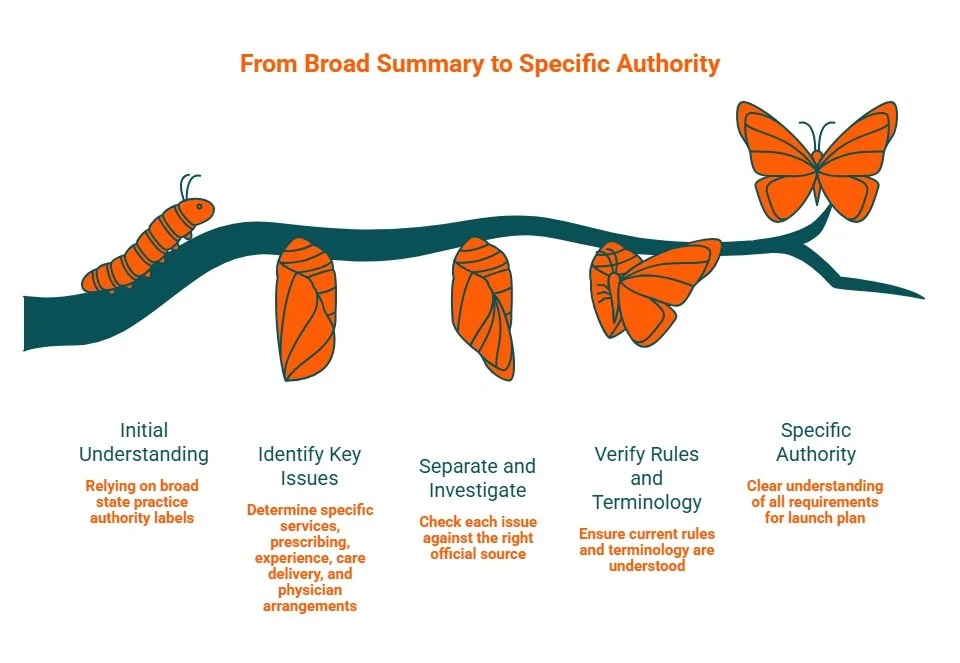
National maps and summaries often sort states into categories such as "full," "reduced," or "restricted" practice. Treat these labels as shorthand for orientation, not as a statement of every requirement that applies to you. For example, a state might be labeled 'full practice authority,' but still require thousands of hours of supervised transition-to-practice time before you can legally operate independently. For background on how the categories are commonly discussed, see this overview of restricted vs. reduced practice states, and treat it as deeper reading rather than legal authority for your state.
A label cannot tell you how current rules apply to your specific plan. Two practices that share a category may still face different questions depending on:
the services offered
prescribing activity
the owner's experience
how care is delivered
any physician arrangements in place
The relevant rules may also be spread across statutes, board guidance, prescribing pages, and forms. The terminology can shift from one source to the next.
Separating the issues lets you check each one against the right source instead of relying on a single broad summary. It also shows you exactly where a gap remains. Use broad summaries to identify what to investigate, and use current official authority to decide what your launch plan can rely on.
7 State Practice Authority Questions to Answer Before You Commit to a Launch Plan
Answer each question for your state, your planned services, and the current date, and record what you find as you go.
Consider a hypothetical NP owner planning a primary-care practice. She expects to prescribe from day one and may add telehealth later. Her state's label gives her a starting assumption, but it leaves several questions open: how prescribing is handled, whether her experience level matters, and what adding telehealth could change.
1. What does my state currently allow an NP to do independently for the services I plan to offer?
Start with your actual clinical plan, not your title or your state's category. List the services you intend to offer at opening, then check how current state rules treat each one. Your list might include routine primary care, chronic condition management, or behavioral health.
Scope can depend on what you do, not only on your credential. If the rules for any service on your list are unclear, flag it for follow-up rather than assuming it is covered. The point of this step is to expose assumptions before they become business commitments: if your lease, staffing, software, contracts, or opening date depends on a particular reading of your authority, verify that reading before you build around it.
2. Does any part of my planned practice trigger a formal physician relationship?
Don't assume every independent NP needs a collaborating physician, and don't assume that independent-practice language rules one out. Depending on the state, an NP practice may involve a formal relationship with a physician. Official sources may call this collaboration, supervision, consultation, delegation, or something else, and the terms are not necessarily interchangeable. Confirm three things:
whether any relationship applies to your practice
which term your state uses
what that term requires
If one does apply, look at the collaborating physician requirements in detail:
Whether the physician must meet eligibility or specialty criteria
What responsibilities the physician and the NP each carry
Whether the requirement covers all of your services or only some
How the relationship must be structured, documented, and communicated
A collaboration service can provide physician support, but it is not the authority on whether your practice is legally compliant. That determination rests on current official requirements and, where needed, qualified professional interpretation. Once you know what the arrangement must cover, you can evaluate options for working with collaborating physicians. Arranging a physician relationship does not, on its own, resolve the other questions on this list.
3. What do I need to verify separately about prescriptive authority?
Practice authority does not settle prescriptive authority. Prescribing may be governed by its own rules, and sometimes by different agencies, so treat it as a separate line of inquiry. Start by identifying what you plan to prescribe, then check:
Your state's general prescribing authority for NPs
Whether additional requirements apply to controlled substances or to particular prescribing activities
Which authorities govern each piece. These may include the state board of nursing, a state pharmacy or controlled-substance authority, and federal DEA regulations and registration requirements where controlled substances are involved
For operative prescribing requirements, rely on current official sources rather than an old article, a forum post, or a vendor summary.
4. Is there an experience or transition-to-practice requirement that affects my opening timeline?
Your state's rules may link the level of NP independence to experience. If they do, transition-to-practice requirements could shape when you can practice on your own, or whether an interim arrangement is needed first. Verify:
Whether any experience or transition requirement applies to you
How qualifying experience is defined and documented
Whether your obligations change once a threshold is met
A threshold question rarely stays contained. If your opening date depends on meeting one, the answer can ripple into contracting, staffing, physician arrangements, software commitments, and other expenses made before you open. This transition threshold also impacts your payer strategy, as most commercial insurance networks and Medicare will not begin credentialing your practice until your independent authority is fully active. If you are close to a threshold, confirm exactly how experience is counted before you set an opening date, and don't rely on a number of hours or years quoted in an older article until you have confirmed the current official requirement.
5. Are written agreements, protocols, chart review, consultation, or recordkeeping requirements involved?
Depending on the state and your practice model, you may need to confirm whether any of the following are involved:
written agreements
practice protocols
periodic chart review
consultation arrangements
filings or official forms
specific records
Each of these can shape daily operations:
Contracting: what any required agreement must contain
Documentation: which records you need to create and keep
Communication workflow: how and when consultation or review takes place
Audit readiness: how you would demonstrate what was done
If an agreement is required, reviewing common physician collaboration agreement clauses can help you prepare questions before signing. A template or a vendor's workflow does not establish what your state requires, and a signed document may be only one part of what the arrangement involves, so confirm the actual requirements first.
6. Which official authority should answer each question, and how will I document what I found?
Official sources should answer launch questions; other sources only help you find them. The difficulty is that you will often find several different answers to the same question. A peer may describe how their own practice runs, a vendor may explain its service model, a blog may report that a rule recently changed, and a professional summary may use terms differently from the statute.
Peer advice, secondary summaries, and vendor content can suggest what to ask, but they may be outdated or incomplete. For launch decisions, work from official sources, generally in this order:
The state board of nursing or nursing regulator
The state's current statutes and administrative regulations
Other state agencies or boards relevant to the issue, such as the medical board for physician-side rules or the pharmacy or controlled-substance authority for prescribing
A qualified attorney or compliance professional when the official language requires interpretation
For every answer, save six things:
the source
the relevant page or provision
the date you accessed it
any update or effective date shown
the conclusion you drew
whether professional review is still needed
That trail shows how each decision was made and speeds up later re-checks. It turns your research into a documented decision process rather than a collection of remembered conversations and browser tabs.
7. What changes to my practice should trigger a fresh review?
A verified answer reflects the rules and your practice model at one point in time. Revisit your findings when you consider:
Adding new services
Starting or expanding prescribing
Changing how you deliver care, such as adding telehealth
Expanding into another state
Changing or ending a physician arrangement
These are prompts to re-check, not signs that a particular legal consequence follows. Rules can also change independently of your plans, so periodic review of official sources is worthwhile even when your practice stays the same.
Build a One-Page State Verification Record Before You Open
Verify, don't assume: Every answer should cite an official source and a date. Mark any answer that depends on interpretation for professional review.
This practice launch checklist turns the seven questions into one record you can update, share with an advisor, and revisit before major decisions. Row 1 shows how to fill it in. The suggested sources show where to look, not what you will find.
| Question to verify | Why it matters | Official source checked | Source/update date | Answer for my practice | Documentation saved | Professional review needed? | Launch impact |
|---|---|---|---|---|---|---|---|
| 1. Scope for planned services | Services may determine what is allowed | Official state source | Date shown on source | Your finding | Saved copy or link | Yes / No / Unsure | May change services offered |
| 2. Physician relationship | Can affect contracts and timing | Board of nursing; medical board | |||||
| 3. Prescriptive authority | May follow separate rules | Board of nursing; pharmacy or controlled-substance authority; DEA | |||||
| 4. Experience or transition | Can affect opening date | Board of nursing; statutes and regulations | |||||
| 5. Agreements and documentation | Creates operational duties | Board of nursing; regulations; required forms | |||||
| 6. Governing source for each answer | Keeps findings traceable | Board of nursing; statutes; other agencies as relevant | |||||
| 7. Review triggers | Keeps findings current | Same sources as above |
A practice manager, compliance advisor, or other team member can help keep this record current, but the conclusions in it should still rest on official sources and, where interpretation is needed, professional review.
For related early-stage decisions, see this guide to opening an independent NP practice.
When to Bring in Professional Legal or Compliance Review
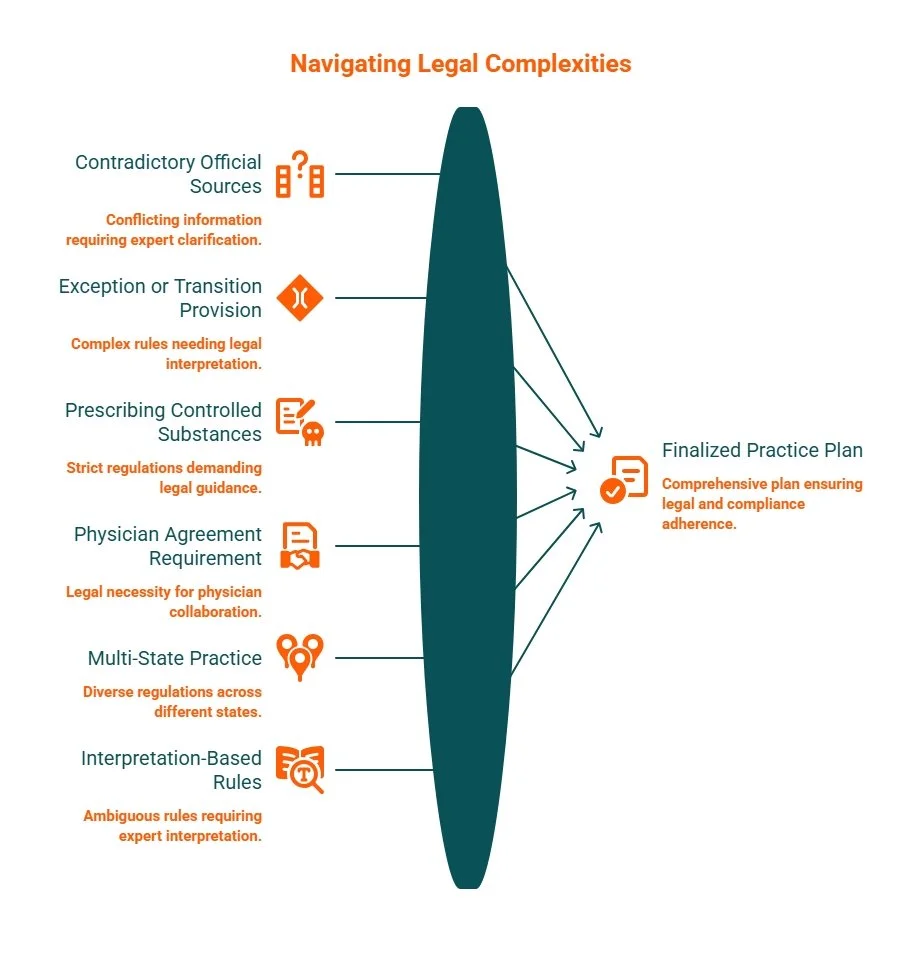
Some answers will be clear from official sources. Others will not. Consider qualified legal or compliance review when:
Official sources appear to contradict each other
You are relying on an exception or transition provision
Your plan includes prescribing, especially controlled substances
Your verification shows that a physician agreement is legally required
You plan to practice in more than one state
Your launch depends on an interpretation rather than a clearly stated rule
In any of these situations, take your completed record to the relevant state authority and a qualified attorney or compliance professional before treating an answer as final. Bring the official sources, their dates, and the specific conclusion you are considering, so the reviewer has a defined question to evaluate rather than a general assessment of your entire business plan.
If you later compare collaboration services, asking how they handle state verification and documentation can show how carefully they approach these issues. A service can support your practice, but it does not replace legal advice.
Frequently Asked Questions
Can I rely on a national NP practice-authority map when planning my practice?
Use it for orientation only. A map or summary may reflect an earlier version of the rules, and it cannot show how those rules apply to your planned services. Before making launch decisions, verify current requirements through official state sources and note the date you checked.
Do I need a collaborating physician to open an independent NP practice?
It depends on your state's current requirements and the details of your planned practice, including services, prescribing, and experience. There is no universal answer. Where a relationship does apply, its name and duties can vary. Check official sources and get qualified professional review before arranging, or ruling out, a physician relationship.
What source should I check first for state NP requirements?
Start with your state's board of nursing and the applicable statutes and regulations. Then check other relevant agencies for issues such as prescribing or physician-side rules. Where the official language requires interpretation, consult a qualified attorney or compliance professional, and keep a record of what each source said and when you checked it.
Your Next Step: Verify Before You Commit
A practice-authority label tells you where to start looking, not what to build your launch around. Answer the seven questions for the practice you actually plan to open, record each source with its date, flag every answer that depends on interpretation, and recheck your conclusions when your practice or the relevant rules change.
Verify the requirements that apply to your planned practice with the relevant state authority and a qualified attorney or compliance professional before relying on them for launch.
Disclaimer: This content is for informational purposes only. Laws, definitions, and deadlines change. Verify current requirements through official sources. This content is not legal advice. No attorney-client relationship is formed through this content. Please consult a qualified attorney in your jurisdiction for legal advice specific to your situation.
Our Editorial Process:
Our expert team uses AI tools to help organize and structure our initial drafts. Every piece is then extensively rewritten, fact-checked, and enriched with first-hand insights and experiences by expert humans on our Insights Team to ensure accuracy and clarity.
About the Physician Collaborators Insights Team:
The Physician Collaborators Insights Team is our dedicated engine for synthesizing complex topics into clear, helpful guides. While our content is thoroughly reviewed for clarity and accuracy, it is for informational purposes and should not replace professional advice.