When Full-Practice Authority Still Calls for NP Collaboration Compliance Review
📌 Key Takeaways
Full-practice authority is only a starting point; each NP practice still needs a separate compliance review before major decisions. Pasted text
Review Your Exact Practice: The author recommends checking your services, prescribing, experience, location, and practice structure instead of relying on one state label. Pasted text
Check Prescribing Separately: Prescribing rules may differ from general practice rules, especially when controlled substances or new services are involved. Pasted text
Recheck After Changes: The author recommends another review when you expand, add services, start prescribing, restructure, or enter another state. Pasted text
Trust Official Sources First: State boards, laws, regulations, and prescribing authorities should guide decisions before maps, vendors, or general summaries. Pasted text
Escalate Unclear Questions: A qualified attorney or compliance professional may help when official rules conflict, remain unclear, or require interpretation. Pasted text
Full-practice status does not replace practice-specific review.
NP owners planning launches or expansions will spot the compliance questions that matter before using the detailed checklist below.
~ ~ ~ ~ ~ ~ ~ ~ ~ ~ ~ ~ ~ ~ ~ ~ ~ ~
A state may be described as giving nurse practitioners full-practice authority, but that label is not necessarily a complete operational checklist for opening or changing an independent NP practice. If you have seen your state on a full-practice list and started planning as though nothing else needs review, you are working from a reasonable but incomplete assumption. Launch planning creates pressure to move quickly, and a broad classification can make the regulatory picture feel settled before you have checked the questions tied to your own practice.
A full-practice designation is a starting point, not necessarily the entire operational review. Before you launch, add a service, begin prescribing, or serve patients in another state, verify the rules that apply to your services, prescribing activity, experience level, and jurisdiction. The goal is not more paperwork for its own sake. It is knowing which questions actually matter before you make a decision. Five variables deserve a separate look, and a short checklist can help you confirm each one against current official sources before you act.
Full-Practice Authority Is a Starting Point, Not the Whole Readiness Review
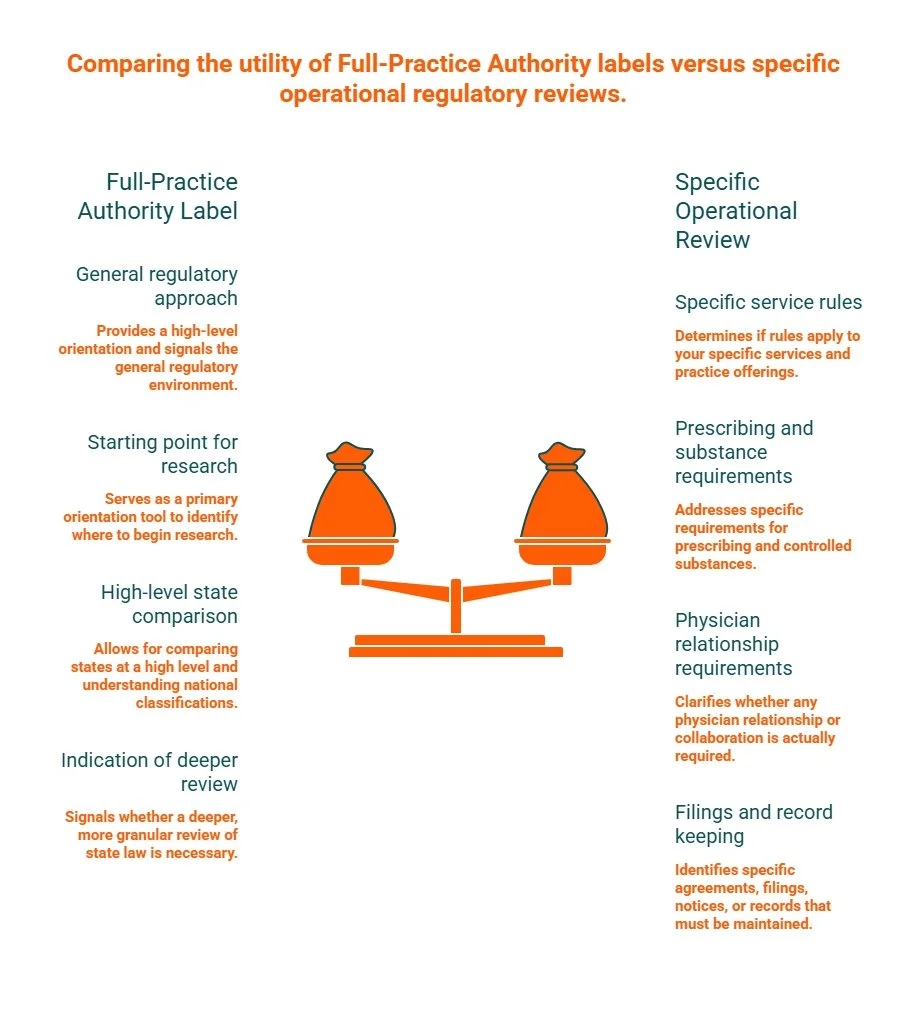
Full-practice authority is a broad classification describing a state's general approach to NP practice. It is useful for orientation because it signals the regulatory environment you are working in and points you toward the right official sources.
What a label cannot do is answer every operational question for your specific practice. The rules that govern a practice can depend on what that practice actually does. Prescribing, experience or transition status, documentation and filing obligations, and the services you offer may each be addressed by provisions that sit apart from the headline classification.
| What a practice-authority label can indicate | What still needs separate review |
|---|---|
| The state's general regulatory approach to NP practice | Whether any rule applies to your specific services |
| A starting point for research | Prescribing and controlled-substance requirements |
| Which official sources to consult first | Any experience or transition-to-practice requirement |
| How states compare at a high level | Whether any physician relationship applies |
| The category national maps commonly place your state in | Agreements, filings, notices, or records you may need to keep |
| Whether deeper review may be needed | Requirements triggered by expansion or practice changes |
None of this means physician collaboration is automatically required in a full-practice state. It means the label does not settle the question either way. Only the current rules for your jurisdiction and activities can do that.
For background on how the categories themselves differ, see our overview of restricted vs. reduced practice states. Use it for context, then confirm specifics with your state.
Five Compliance Variables to Review Separately
Each of these variables can change what your practice needs, and each may be governed by a different rule or agency. Review them one at a time rather than assuming a single answer covers all five.
1. Prescriptive authority
Prescriptive authority is an NP's legal ability to prescribe medications, and it may be regulated through rules distinct from the general practice-authority label. The question is not whether prescribing always creates an additional physician requirement. It is whether your planned prescribing changes what you must verify, which official authority controls that question, and whether its answer differs from the rule governing general practice authority. Controlled substances may involve additional requirements, so confirm those with the relevant prescribing authority before you begin.
For example, imagine a hypothetical NP owner who has run a practice for two years without prescribing and now plans to add medication management. The original launch review may never have examined prescribing. The new service line justifies a fresh look at the prescribing rules before the first prescription is written.
2. Transition-to-practice or experience-based requirements
Some regulatory structures distinguish NPs by experience. A transition-to-practice requirement, where one exists, is a period or threshold an NP may need to complete before certain obligations change. Whether such a requirement applies, and what it involves, depends on the jurisdiction.
Consider two hypothetical NPs licensed in the same state: one with many years of practice and one recently licensed. Even under the same practice-authority label, they should not assume their obligations are identical. Each should confirm whether any experience-based rule applies and how their own practice history is counted. For instance, in Colorado, a newly licensed NP must complete 1,000 hours of mentored practice before earning full prescriptive authority, even though the state is broadly classified as a full-practice jurisdiction. Neither should rely on an assumed hour threshold, time period, or eligibility rule without direct confirmation from the state nursing board.
3. Physician relationship triggers
Terms like "collaboration," "supervision," "consultation," and "protocol" do not carry the same meaning everywhere. In general usage, collaboration suggests a consultative working relationship, while supervision suggests more directive oversight. Your state's legal definitions control, and they may differ from both.
Depending on your jurisdiction, activities, prescribing, experience, and practice structure, a physician relationship might be required, might apply only to certain services, or might not apply at all. Advisors and vendors sometimes use these terms loosely, so anchor your review in the language your state's official sources use. A relationship you do not need adds cost and administrative work, while one that does not match the rule may not satisfy it.
Avoid inferring the answer from a national label, another state's requirements, or a service provider's preferred terminology. When two sources use different terms, identify the controlling authority first, then work from how that authority defines the relationship relevant to your activity.
4. Documentation, agreements, and filing requirements
Operational compliance can involve more than fitting a definition. Depending on the state, a practice may need to keep certain agreements, submit notices or filings, maintain protocols, or retain specific records. Confirming what applies, and keeping evidence that you did, is a separate task from knowing your state's classification.
A signed document is one part of that picture, not proof of compliance on its own. Nor should you assume that one agreement covers every service or activity your practice offers. For a closer look at where records tend to fall short, see our article on documentation gaps in NP-physician collaboration.
5. Practice changes
A compliance review is accurate only for the practice it examined. Expanding into telehealth, serving patients in another state, adding a materially different service line, starting to prescribe, or restructuring the practice can each change which rules apply.
A hypothetical practice that begins seeing telehealth patients in a second state shows why. Its home state's label says nothing about the new jurisdiction, and requirements copied from the first state may not carry over. The second state's rules need their own verification from the local regulatory bodies.
Use a Compliance-Readiness Checklist Before You Act
Run this checklist at three points: before launch, before a major service change, and before entering a new jurisdiction. Each row names something to verify, not a conclusion, and every answer should come from a current official source. Work through the rows in order, since the first two answers shape everything below them.
| Review question | Why it matters | What to verify |
|---|---|---|
| What is my current state or jurisdiction? | Rules are jurisdiction-specific | Current board guidance, statutes, and regulations |
| What services will the practice provide? | Requirements may depend on the activity | Scope and practice rules for those services |
| Will I prescribe medications or controlled substances? | Prescriptive authority may be separately regulated | Current prescribing rules |
| Is there any experience or transition requirement? | Career stage may affect obligations | Official state guidance |
| Does any physician relationship apply to my situation? | Relationship requirements may differ by activity | Current governing authority |
| Are there agreements, notices, filings, protocols, or records to maintain? | Operational compliance may include documentation | Current board or regulatory instructions |
| Am I expanding into telehealth or another state? | A new jurisdiction can change requirements | Rules for each applicable jurisdiction |
| Has anything material changed since my last review? | Earlier conclusions may become stale | Current authority, rechecked |
For each row, record the source you checked, the date you checked it, and what it said. That record makes the next review faster and gives an attorney or compliance advisor something concrete to work from. It also creates a clean handoff whenever an owner, operations manager, or staff member needs to understand how the practice reached its conclusion.
Some rows may turn up nothing that applies to your practice. That is a useful result, because it keeps you from adding agreements, filings, or physician relationships your situation does not call for.
If you work with a collaboration service, or are evaluating one, ask how it approaches state verification. These questions to ask about state verification and documentation can structure that conversation.
What Sources Should You Trust for the Final Answer?
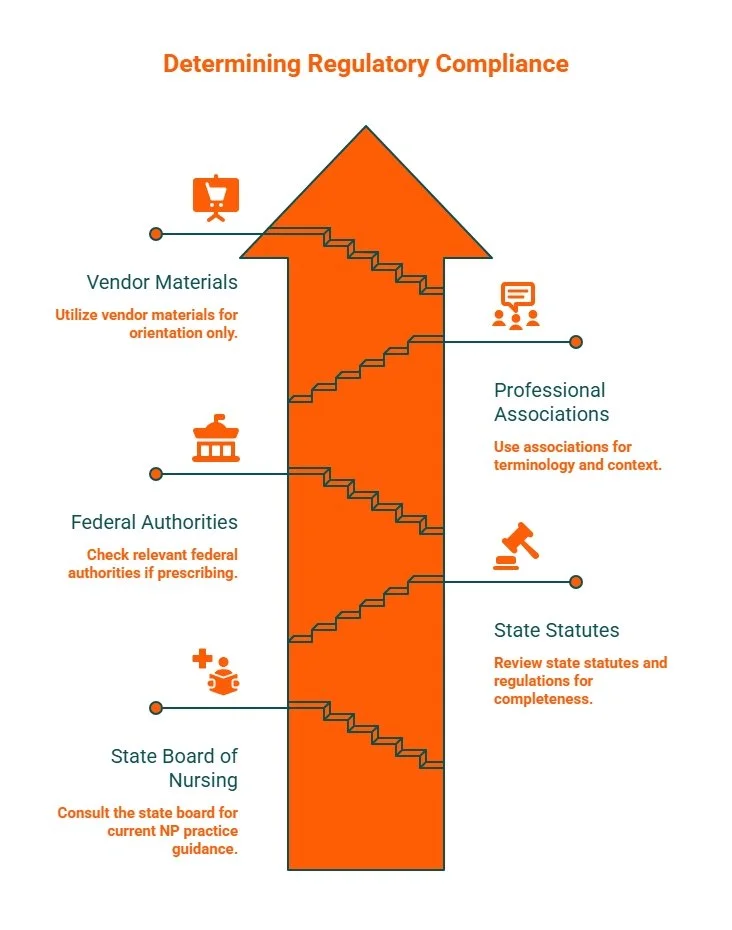
Official sources outrank secondary ones, and not every source carries the same weight. Work through them in this order, moving down the list only when a higher source does not answer your question:
The relevant state board of nursing or equivalent regulator, for current NP practice guidance.
State statutes and administrative regulations, especially where board summaries are incomplete.
The relevant prescribing, pharmacy, controlled-substance, or applicable federal authority, if your practice prescribes.
Professional associations and national regulatory organizations, for terminology and context.
Vendor, advisor, and blog materials, including practice-authority maps, as secondary orientation only. Vendor material is best used to understand that vendor's own services, not as evidence of what a rule requires.
When a secondary summary conflicts with an official source, the official source controls the regulatory question, and the summary serves only as context. Whatever you rely on, confirm that it is current by checking its publication, update, effective, or revision date where one is available. Rules and guidance change, and a summary that was accurate when written may not reflect what is in effect today.
As you review, keep three categories apart: what an official source states, what varies with your services or experience, and what still requires interpretation. You can record the first directly. The last belongs with a qualified attorney or compliance professional, because no general guide can determine how a rule applies to your individual circumstances. When official sources conflict or leave your situation unresolved, escalate the question rather than filling the gap with an assumption.
When Professional Review Is Worth It
Professional review earns its value when a decision depends on interpreting a rule rather than simply locating it. Official sources answer many questions directly, but some situations call for individualized interpretation from a qualified attorney or compliance professional. Consider that review when:
Official sources conflict with each other or are ambiguous.
Your practice will prescribe controlled substances.
You are entering a new state.
A transition or experience rule may apply to you.
A physician agreement, filing, notice, or protocol may be required.
You are restructuring the practice or adding a materially different service.
The objective is not legal review for every routine operating decision. It is recognizing when general information no longer resolves your individual question.
A rule that seems clear can still deserve a second look. Plain wording may sit alongside definitions, exceptions, or related provisions elsewhere. Even when the wording holds up, a misreading that would materially affect your launch, prescribing, contracting, or practice structure justifies an additional check before you act. A professional can confirm that your reading holds for your facts, and you should ask for that confirmation in writing so it becomes part of your compliance record.
A collaboration service can support the operational side of a physician relationship once you have determined that collaboration is relevant. It is not a substitute for legal advice or for the regulator's own guidance. Keeping those roles separate helps you get each answer from the right source.
Frequently Asked Questions
Does full-practice authority mean an NP never needs a collaborating physician?
There is no universal answer. Whether any physician relationship applies depends on your jurisdiction, the services you provide, your prescribing activity, your experience, and how your practice is structured. Depending on those facts, the answer may be that no physician relationship applies, or that one applies only to certain activities. Always check your local board's latest statutes to confirm your exact obligations.
Should I review prescribing rules separately from general practice authority?
Yes. Prescriptive authority may be governed by rules distinct from the overall practice-authority classification, and controlled substances may carry additional requirements. Treat prescribing as its own review item and confirm it with the relevant state authority. If your services change to include prescribing, repeat the review before relying on an earlier conclusion.
Can I rely on a national practice-authority map when opening a practice?
Use a map for orientation. It can tell you where to start looking, but it is not the final authority for an individual compliance decision. Maps can lag behind changes in law or guidance, and they rarely capture activity-specific, experience-based, documentation, or prescribing questions. Confirm current requirements with the relevant state board, statutes, and regulations.
When should I repeat a compliance review?
Repeat it when you launch, enter another jurisdiction, add a materially different service, change your prescribing activities, or restructure the practice. A new review also makes sense when official guidance is ambiguous or conflicts with what you relied on before. Keep the records from each review so you can see what changed, since the conclusion should fit the practice as it operates now.
Ask the Question That Fits Your Practice
"Is my state full practice?" is a reasonable first question, but it is only the first one. The question that protects a launch or expansion focuses directly on execution. By independently verifying the board regulations, prescriptive authority limits, and transition requirements for your specific clinic model, you build a resilient compliance framework from day one. Bring in a professional review where those directives remain unclear. Then document what you found and revisit the checklist whenever the practice changes. That habit turns a broad classification into a repeatable readiness process.
If your review indicates that physician collaboration may be relevant to your practice, you can contact Physician Collaborators for a free consultation about collaboration support. That conversation covers collaboration support, not legal advice.
Disclaimer: This content is for informational purposes only. Laws, definitions, and deadlines change. Verify current requirements through official sources. This content is not legal advice. No attorney-client relationship is formed through this content. Please consult a qualified attorney in your jurisdiction for legal advice specific to your situation.
Our Editorial Process:
Our expert team uses AI tools to help organize and structure our initial drafts. Every piece is then extensively rewritten, fact-checked, and enriched with first-hand insights and experiences by expert humans on our Insights Team to ensure accuracy and clarity.
About the Physician Collaborators Insights Team:
The Physician Collaborators Insights Team is our dedicated engine for synthesizing complex topics into clear, helpful guides. While our content is thoroughly reviewed for clarity and accuracy, it is for informational purposes and should not replace professional advice.