Adding a New State to a Telehealth NP Practice: A Pre-Launch Compliance Review
📌 Key Takeaways
A new telehealth state should open only after licensure, telehealth, collaboration, workflow, and evidence requirements are documented and resolved. Pasted text
Define the Care Scenario: The author recommends confirming patient location, clinicians, services, prescribing, and ownership questions before researching state requirements. Pasted text
Verify State Authority: Each NP’s license, practice authority, and any telehealth pathway should be checked against current official state sources. Pasted text
Check Collaboration Fit: Existing physician coverage may not transfer, so the author recommends confirming state-specific eligibility and agreement requirements. Pasted text
Build Requirements Into Workflow: Verified rules should shape scheduling, intake, escalation, evidence records, and named ownership before launch. Pasted text
Keep Blockers Closed: The author recommends delaying launch while blockers or items needing professional review remain unresolved. Pasted text
The record, not the schedule, determines launch readiness.
Telehealth NP practice owners and compliance teams will gain a clear launch framework from the review process that follows below.
~ ~ ~ ~ ~ ~ ~ ~ ~ ~ ~ ~ ~ ~ ~ ~ ~ ~
Adding a state to a telehealth NP practice requires a documented launch review, not just a working booking system. The question is not whether your practice is "telehealth ready." It is whether the new state has passed a review of licensure, telehealth authorization, physician collaboration, and internal workflow.
Your scheduling platform may already let a patient in another state book a visit. That does not answer whether your practice is cleared to deliver care there. A new state is a launch decision, not a checkbox.
Each of those review areas raises its own questions. Depending on the state, they can intersect differently than they do where you already practice. For example, an NP licensed in State A might operate independently, but expanding into State B could suddenly require a signed collaboration agreement with a state-licensed physician who reviews 10% of all patient charts. The framework below helps your team decide what needs verification, who owns it, and what evidence to keep. It is not state-specific legal advice. It also leaves entity formation, tax, malpractice coverage, and payer enrollment to separate specialist review.
Establish the Jurisdictional Facts Before Researching Requirements
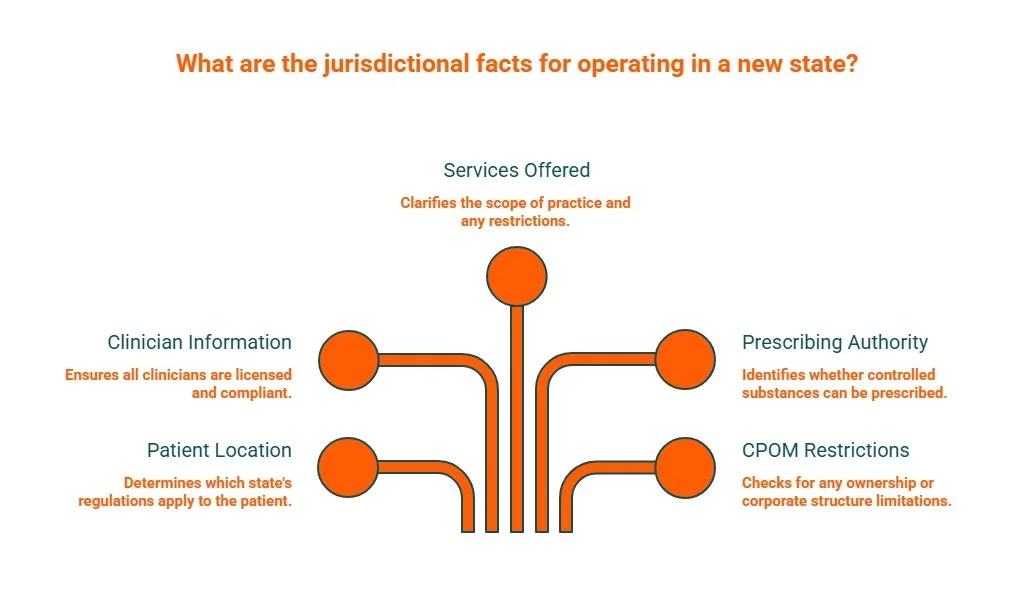
Define the care scenario before researching requirements. Research stays accurate when the team knows exactly what it is evaluating. A question as broad as "Can we operate in this state?" is hard to check against any official source.
Record these facts first:
Patient location during the encounter. This is an important fact to identify in any cross-state review. Confirm how it applies to your planned services with the relevant authority or with qualified legal or compliance counsel.
The clinicians involved. List each NP who will see patients there and their current license status.
The services in scope. Include specialty focus and visit types.
Whether prescribing is in scope. Note controlled-substance prescribing separately from other prescribing.
Whether Corporate Practice of Medicine (CPOM) restrictions apply. Some states prohibit NPs from owning a medical practice or require a specific percentage of physician ownership to operate.
Expect the answers to come from more than one place. Requirements may be spread across several boards, regulators, or statutes. A page that answers the licensing question may say nothing about telehealth, collaboration, prescribing, or documentation.
These facts form the first rows of the matrix below. If any of them changes, revisit the review.
New-State Telehealth Launch Readiness Matrix
| Review area | Question to resolve | Official source checked | Requirement or conclusion | Owner | Evidence retained | Status | Professional review? | Recheck date |
|---|---|---|---|---|---|---|---|---|
| Care scenario | Which patients, services, and clinicians are in scope? | Internal plan | Operations lead | Scenario summary | Unresolved | No | ||
| Jurisdiction | How does patient location affect which requirements apply? | State regulator or statute | Compliance lead | Source link, decision note | Unresolved | Yes | ||
| NP authority | What license or authority does each NP need? | Board of nursing or APRN regulator | Compliance lead | License verification | Unresolved | Yes | ||
| Telehealth pathway | Does a telehealth-specific pathway apply? | Licensing or telehealth regulator | Compliance lead | Source link, registration record | Unresolved | Yes | ||
| Collaboration | Is collaboration or supervision required, and does our arrangement qualify? | Nursing or medical board, governing law | NP owner | Agreement, eligibility check | Unresolved | Yes | ||
| Prescribing (if in scope) | What prescribing requirements apply? | State and federal authorities | NP owner | Source links, registrations | Unresolved | Yes | ||
| Workflow | Are scheduling, intake, and escalation configured? | Internal record | Operations lead | Configuration notes | Unresolved | No | ||
| Sign-off | Is every row resolved or justified? | Internal record | NP owner | Signed approval | Unresolved | No |
Every row starts as Unresolved while research is in progress. Record what each source established. At final review, convert each row to one of four statuses:
Resolved: verified against a current official source, built into the workflow, and supported by retained evidence.
Not applicable: with a recorded rationale.
Needs professional review: the source is ambiguous or the interpretation is high-risk.
Blocking: a launch blocker, meaning an unresolved item the state cannot open without.
Anything the team considers "probably fine" belongs in one of the last two. That keeps an assumption from passing as a verified fact.
Verify NP Authority and Any Telehealth-Specific Pathway
Holding a license and having authority for your planned services are separate questions. Practice authority here means what the NP is permitted to do in the target state: the scope of practice and any conditions attached to it. A license tells you the NP may practice; it does not tell you whether that practice covers what you plan to offer.
In this review, "telehealth registration" means any state-issued authorization for remote practice that is separate from a full license. Whether one exists, and what it allows, must be confirmed state by state.
Work through these questions with the target state's board of nursing, APRN regulator, or governing statute:
What license or authorization does each NP need to treat patients located in this state?
Does the state recognize a relevant pathway, or none at all? Possibilities include a compact privilege, a telehealth registration, a special registration, or a waiver. Another state's pathway tells you nothing about this one.
If a pathway exists, what does it permit and exclude?
Do practice-authority limits, such as specialty restrictions, affect your planned services?
What renewal requirements, effective dates, and ongoing obligations apply?
For each answer, record:
the exact official page or regulation relied on
the date checked and who checked it
any applicable effective date
the renewal or recheck date
That record gives a future reviewer something to verify.
Third-party guides can help you find the right authority, but each conclusion should trace back to the regulator or governing law. Where the language is ambiguous, mark the row "Needs professional review" and route it to qualified legal or compliance counsel.
If prescribing is in scope: Prescribing, particularly of controlled substances, may create an additional review workstream involving state and federal authorities. Check current requirements with the applicable authorities before launch rather than relying on memory or secondary summaries.
Determine Whether Collaboration or Supervision Becomes a State-Specific Launch Dependency
An existing physician relationship does not settle the collaboration question in a new state. Collaboration and supervision both describe a formal NP-physician relationship, but neither term should be assumed to mean the same thing in every state. Depending on the state, the NP, and the service model, a physician relationship may or may not be required, and its conditions can vary.
Verify through the state nursing board, medical board, or governing law:
Does collaboration or supervision apply to this NP and service model in the target state?
If it applies, what licensure, physical-location, specialty, or eligibility conditions must the physician meet?
What must the arrangement include? This can cover agreement terms, chart review, communication, prescribing, or documentation.
Can the current arrangement be used as is, does it need amendment, or is new coverage required?
Consider a hypothetical practice whose collaborating physician covers its existing states. The team assumes the relationship carries over. A fit check might confirm the physician qualifies. It might instead reveal a gap in licensure, location, eligibility, or agreement terms. Until one of those outcomes is documented, the collaboration row stays open.
A signed agreement answers only part of the question, since eligibility, agreement content, and review expectations may each need verification. For a closer look at agreement terms, see these collaboration agreement clauses to review.
If the review shows that new coverage is needed, Physician Collaborators states that it provides collaborating physicians for telemedicine practices. A physician match is not regulatory approval, however. Any arrangement, from any source, still needs the same fit check against the target state's current requirements. It also addresses one workstream rather than replacing the broader review.
When evaluating any collaboration service, these questions to ask about state verification and documentation can help. Ask what records the service can provide for your evidence file.
Convert Requirements Into a Remote Operating Workflow and Evidence File
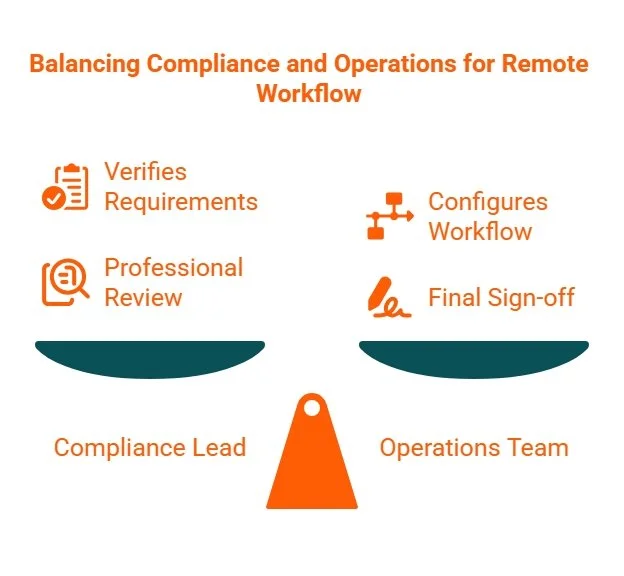
Verified requirements change nothing until someone builds them into the workflow. Picture a hypothetical practice whose compliance lead confirms the new state's requirements and marks those rows complete. Scheduling and intake, however, still accept patients from that state under the old workflow. The requirement is understood, but the practice is not yet operating within it.
Close that gap by splitting responsibility. In one workable setup:
the compliance lead verifies the requirement
operations configures the launch workflow
any outside advisor takes the items routed for professional review
the NP owner signs off that the required evidence is retained
One named person should hold final launch sign-off authority, so "almost resolved" cannot quietly become "approved to launch." One named person should also own future changes to the workflow.
Build an evidence file that includes:
The official sources relied on, with the date each was checked
Who verified each item and the decision it supported
Licenses, registrations, collaboration agreements, acknowledgments, and approvals, where applicable
Workflow configuration records, such as scheduling rules and escalation steps
Renewal and recheck dates, each with a named owner
Credentials, rules, service lines, and physician relationships all change over time, which is why every date in the file needs an owner. Treat the file as an internal control. Some records may also be legally required, so confirm any specific form, retention period, or review frequency with the issuing authority before treating it as mandatory.
Remote care also needs an escalation path for encounters outside the approved workflow. One common case is an existing patient who travels and seeks care from another state. Another is a patient who appears to be located somewhere unexpected. Where appropriate and verified, scheduling and intake should capture the information needed to route each encounter correctly. Decide who handles these cases and how the decision is recorded. For common weak points in collaboration records, see this guide to documentation gaps in NP-physician collaboration.
Run a Launch-Readiness Review Before Opening the State
The launch gate turns research into a documented decision. Run six steps in order:
Define the care scenario.
Verify NP authority.
Verify the telehealth pathway.
Verify collaboration requirements.
Configure the workflow and evidence file.
Resolve blockers, obtain any required professional review, and sign off.
Before sign-off, the NP owner and compliance lead should answer each question with a documented yes:
Is clinician authority documented for every NP?
Are telehealth-specific requirements resolved, or marked not applicable with a rationale?
Is collaboration coverage resolved where applicable?
Are scheduling, intake, and escalation configured?
Is supporting evidence retained in the file?
Does every renewal and recheck date have a named owner?
Is any unresolved assumption still being treated as fact?
Pressure to open on schedule can make an "almost resolved" item feel resolved. Keep the state closed while any launch blocker remains or any row awaits professional review. A completed matrix documents your review; it does not certify compliance. It shows what was checked, against which source, and who approved it.
Common New-State Expansion Mistakes
These shortcuts can sound reasonable during planning, yet each can leave a requirement unverified:
Assuming telehealth works the same everywhere. A telehealth-only practice with no office in the state can still face state-specific licensure and practice questions. Your current states are a starting point, not evidence about the new one.
Assuming collaboration coverage transfers. "We already have a collaborating physician" opens the fit check rather than closing it.
Treating a vendor statement as the regulatory source. A vendor saying you are "covered" can inform workflow, but the conclusion should come from the regulator or governing law.
Relying on another practice's setup. Its arrangements may differ from yours.
Skipping the decision note. Without one, a future reviewer cannot tell why a requirement was considered satisfied.
Checking once and never again. Credentials renew and rules change, so every recheck needs an owner.
Frequently Asked Questions
Do I automatically need a new collaborating physician every time my telehealth NP practice adds a state?
There is no universal answer. First verify whether collaboration or supervision applies to that NP and service model in the target state. If it does, determine whether your existing physician relationship satisfies the applicable requirements, including any physician eligibility or agreement conditions that need current verification. If it doesn't, new coverage may be needed.
Is a telehealth registration the same as an NP license?
The two can represent different legal pathways, so treat them as separate items. Verify with the target state's authority exactly what each allows and which license or registration each clinician needs for your planned services.
What should a practice keep in its new-state compliance file?
A practical file holds:
the sources reviewed, with enough context to show what question each one answered
decision notes and each item's owner
license or registration evidence
collaboration documentation where applicable
the approval date
recheck and renewal dates
These are sound internal controls. Confirm with the relevant authority which items, if any, are legally mandated.
How often should a telehealth practice recheck state requirements?
No single cadence fits every practice. Tie rechecks to:
credential renewals
regulatory changes
changes in services, prescribing, clinicians, or collaboration arrangements
a periodic internal review your team schedules
Confirm any legally required interval with the issuing authority.
Make the Launch Decision From the Record
A new state is ready when the record shows it, not when the schedule says so. With the scenario defined, clinician authority verified, collaboration checked, and workflow configured, your team can see what is settled and what still needs work.
Use the matrix to document each requirement, owner, source, and unresolved blocker before launch. For multi-state planning context, see this framework on telehealth across borders.
If collaboration coverage is an open workstream, Physician Collaborators offers a free consultation. A consultation or physician match can clarify collaboration options, but it is one part of the broader review, not proof of regulatory compliance. Verifying requirements with the state's regulators remains a separate step.
Disclaimer: This article is for general informational purposes only and does not constitute legal, regulatory, compliance, medical, or other professional advice. Requirements may vary by jurisdiction and can change over time. Confirm current requirements with the relevant licensing boards, regulators, qualified legal/compliance professionals, and other appropriate authorities before launching services in a new state.
Our Editorial Process:
Our expert team uses AI tools to help organize and structure our initial drafts. Every piece is then extensively rewritten, fact-checked, and enriched with first-hand insights and experiences by expert humans on our Insights Team to ensure accuracy and clarity.
About the Physician Collaborators Insights Team:
The Physician Collaborators Insights Team is our dedicated engine for synthesizing complex topics into clear, helpful guides. While our content is thoroughly reviewed for clarity and accuracy, it is for informational purposes and should not replace professional advice.