Adding Primary Care, Behavioral Health, or Urgent Care? 7 Collaboration Questions NP Owners Should Review First
📌 Key Takeaways
The author recommends that NP practice owners review collaboration arrangements before adding services because workflows, prescribing, and state requirements may change. Pasted text
Review Before Launch: A new service line deserves a fresh collaboration review, even when the current physician relationship works well.
Check Collaborator Fit: Relevant experience, communication style, and availability should match the patients, cases, and questions the new service creates.
Recheck Regulated Workflows: Prescribing changes and state-specific collaboration rules need confirmation from current, authoritative regulatory sources before launch.
Update Only When Needed: Review agreements, protocols, chart-review processes, and escalation workflows before deciding which parts actually require changes.
Document Every Decision: Record changes, responsibilities, open verification items, and review dates so important compliance questions do not remain unresolved.
New services should trigger review, not automatic replacement.
NP practice owners and administrators will use these questions to identify what still fits and what needs verification in the guidance below.
~ ~ ~ ~ ~ ~ ~ ~ ~ ~ ~ ~ ~ ~ ~ ~ ~ ~
NP practice owners adding primary care, behavioral health, or urgent care should review their collaboration arrangement before launch. A new service line changes more than the menu of care your practice offers. It can shift patient mix, prescribing, and escalation in ways the original setup never anticipated.
If your current relationship with a collaborating physician works well, you may reasonably wonder why it needs another look. The arrangement was likely built around the services you offered when you signed. Whether you own the practice or manage its operations and compliance, the seven questions below help you check what still fits, what needs updating, and what needs verification from an authoritative source. They are review questions, not universal legal answers, because collaboration requirements vary by state.
Why a New Service Line Should Trigger a Collaboration Review
A new service line is a reason to review your arrangement, not proof that it is broken. Three terms keep the review precise. A collaboration arrangement is the full working relationship with your collaborating physician, including communication, chart review, and escalation habits. A collaboration agreement is the written document, where one exists. A service line is a distinct category of care the practice offers, such as urgent care.
A new service line does not automatically make the agreement outdated or call for a different physician. It means assumptions built into the arrangement deserve a fresh check. Instead of asking "Do I need a new collaborator?", ask "What was designed for the old practice, and does it still fit?" That framing also protects a physician relationship that still works, rather than disrupting it before you know a change is necessary.
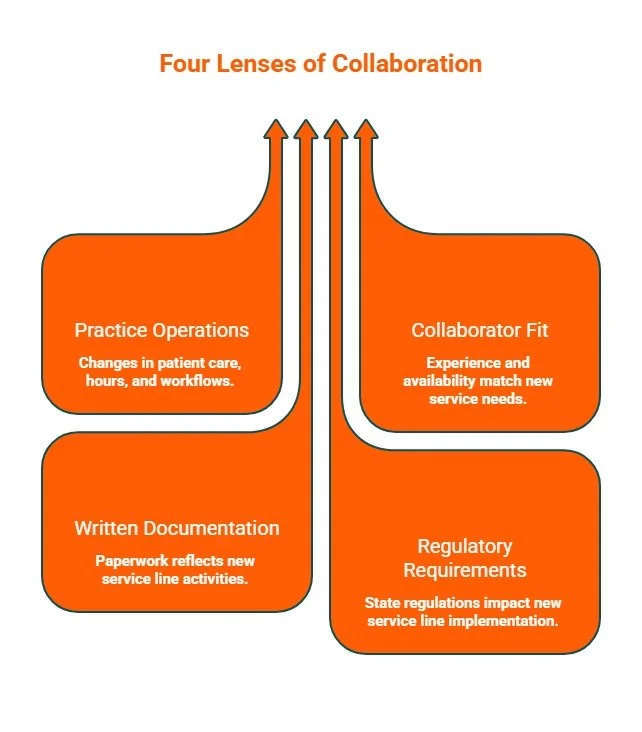
Four lenses keep those questions separate:
Practice operations: which patients, visits, hours, and workflows change
Collaborator fit: whether experience and availability match the new work
Written documentation: whether the paperwork describes what the practice will do
Regulatory requirements: whether your state treats the new service differently
The first three are internal judgments you can make with your team and collaborating physician. The fourth belongs to the applicable licensing board, statute, or regulation, ideally interpreted with a qualified legal or compliance professional.
7 Collaboration Questions to Ask Before You Add the Service
Use this checklist as a pre-launch meeting agenda. The detail for each question follows.
| Review question | Why it matters | Who helps answer | What may need updating | State verification? |
|---|---|---|---|---|
| 1. What is changing? | Anchors every later answer | Owner, clinical lead | Service description | Rarely on its own |
| 2. Does the arrangement cover the new scope? | Paperwork may reflect the old service mix | Owner, physician, counsel | Agreement, protocols | Possibly |
| 3. Is the collaborator still a fit? | Fit shapes useful collaboration | Owner, physician | Physician arrangement | For any qualification rules |
| 4. Do chart-review and communication workflows change? | Volume and case mix may shift | NPs, physician | Review and escalation process | Possibly |
| 5. Does prescribing change? | Prescribing is regulated | NPs, counsel | Prescribing workflow | Yes |
| 6. What needs state re-verification? | Rules vary and change | Compliance lead, counsel | Verification log | Yes |
| 7. What should be documented? | Keeps decisions and owners clear | Owner, administrator | Review record | Possibly |
1. What exactly is changing in the practice?
Describe the new service before anyone opens the agreement. List the expected patient population, visit types, hours, any telehealth component, likely escalation needs, and new medications your NPs will prescribe. Keep this description operational; clinical protocols are a separate exercise.
2. Does the current arrangement clearly cover the changed scope?
Read the agreement and related protocols for what they actually say, not what you remember. Language written for a narrower practice may be silent on the new services or settings, and that silence is worth recording. This guide to collaboration agreement clauses covers areas worth examining. Whether your state requires specific language or a formal amendment belongs to Question 6.
3. Is the current collaborator still an appropriate fit?
A licensed physician may meet a minimum requirement, but fit is broader. Ask whether:
their experience is relevant to the new workflow,
they are comfortable discussing these cases,
their communication style suits the questions your NPs will bring,
their availability matches when those questions will arise.
Treat specialty as a fit criterion, and verify separately whether your state sets qualification rules. Replacing a collaborator is one possible outcome, not the default.
4. Do chart-review and communication workflows need to change?
A new service can change chart volume, case mix, and the questions that need physician input. Review how charts are sampled, how feedback reaches the NP and gets recorded, what response time both sides expect, and how urgent questions escalate. Copying the current process may work, but make it a deliberate choice.
This resource on chart-review and physician communication expectations covers preparation. Confirm any required review frequency with the applicable authority. Don't infer a universal chart-review percentage, frequency, or response standard from a general article.
5. Does the service change prescribing or another regulated workflow?
Prescribing changes require verification before launch. New medications, drug categories, or prescribing patterns are a signal to pause, because prescribing and controlled-substance rules can differ by state and drug category. Confirm current requirements with the applicable state board and prescribing authority before the first patient is seen.
6. What jurisdiction-specific requirements need to be re-verified?
Depending on your state, this may include whether collaboration is required, physician eligibility, agreement content or filings, prescribing rules, and documentation obligations. States and secondary sources also use "supervision," "collaboration," "oversight," and "consultation" differently, so work from the terms your state defines.
Go to the controlling sources:
the board of nursing or NP licensing authority,
state statutes and regulations,
the medical board for physician-side requirements,
official prescribing or controlled-substance authorities, where medications are involved.
Secondary sources such as commercial pages, blogs, and anonymous or scraped regulatory summaries can help you locate those sources, but they should not replace them. Commercial collaboration services work the same way. These state verification and documentation questions clarify what a service checks, but its answers do not replace the authoritative source or qualified legal advice.
Review vs. verify: Scope, collaborator experience, communication, and chart-review logistics are internal review items. Collaboration requirements, physician qualifications, prescribing rules, and required forms or frequencies need authoritative verification.
7. What should be documented before launch?
Record what changed, who owns each workflow, which documents were updated, which verification items remain open, and the next review date. In a small practice without dedicated compliance staff, an informal review can easily go unrecorded, so assign one person to keep the record. Documentation supports the process; it does not replace meeting the requirements that apply.
How the Review Emphasis Changes by Service Line
Every expansion uses the same seven questions, but each service line shifts the weight.
| Review area | Primary care | Behavioral health | Urgent care |
|---|---|---|---|
| Collaborator fit | Breadth across ongoing care | Behavioral-health experience | Experience with episodic, higher-acuity visits |
| Workflow | Chart volume and continuity |
Clear role boundaries • Cross-state licensing triggers: If behavioral health visits include a telehealth component reaching patients across state lines, verify whether the collaborator holds active licenses in those specific jurisdictions. |
Response availability |
| Prescribing | Ongoing medication management | New medication categories | Episodic prescribing |
| Escalation | Routine follow-up questions | Defined path for raising concerns | Time-sensitive questions during service hours |
| Verification focus | Any qualification and prescribing rules | Any specialty and medication rules | Any qualification and prescribing rules |
Primary care
Consider a hypothetical practice moving from limited episodic visits to ongoing primary care. Patients return for years, so chart volume grows and medication management becomes routine. Check whether the review workflow and the collaborator's availability scale with that load.
Longitudinal care also means the collaborator may follow the same patient across many reviews, so agree on how ongoing cases are flagged. Assess relevant experience rather than assuming a family medicine or internal medicine collaborator is automatically required.
Behavioral health
Imagine a general practice adding behavioral-health visits. The existing physician may or may not be comfortable discussing those cases, medication questions may change, and everyone needs clear role boundaries. Agree in advance on who handles which questions and how quickly the collaborator responds when a concern is raised.
Relevant experience is a reasonable criterion. Still, don't assume every behavioral-health practice needs a psychiatrist collaborator; any specialty requirement must be verified. This reading on behavioral health collaborator fit offers one perspective.
Urgent care
A hypothetical practice adding urgent-care hours may see higher-acuity visits at times when the collaborator was never expected to respond. Review whether availability and escalation match those hours, whether chart review reflects the new case mix, and whether service scope or prescribing changes.
If the service runs evenings or weekends, confirm who covers questions when the usual collaborator is unavailable, and record that backup in writing. Do not assume an emergency medicine collaborator is mandated without checking state requirements.
Turn the Review Into a Pre-Launch Action List
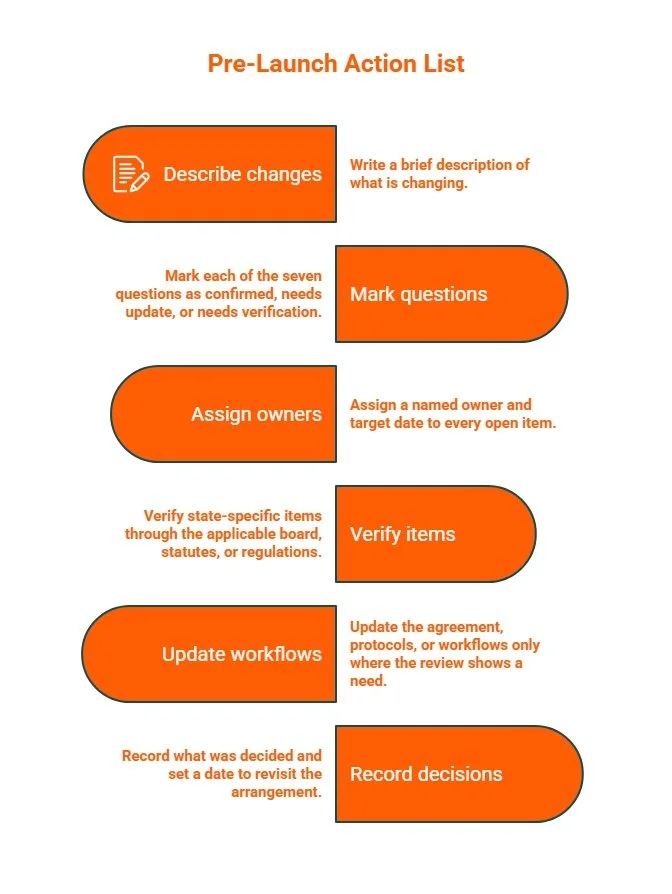
Convert the answers into a sequence your team can finish before the first patient is scheduled:
Write a brief description of what is changing.
Mark each of the seven questions as confirmed, needs update, or needs verification.
Assign a named owner and target date to every open item.
Verify state-specific items through the applicable board, statutes, or regulations, with qualified professional input where needed.
Update the agreement, protocols, or workflows only where the review shows a need.
Record what was decided and set a date to revisit the arrangement.
Assigning owners deserves extra attention. When the owner, collaborating physician, counsel, and staff each assume someone else is handling an item, verification can stay open past launch. Schedule pressure makes this more likely, so leave room in the timeline for open items to close before the start date rather than after it.
If the practice has no dedicated administrator, the owner may hold most of these items, which makes target dates more important. Finish state verification before signing any revised agreement.
This article on documentation gaps in NP-physician collaboration offers more on keeping records consistent. Treat the list as a planning tool; on its own, it is not a complete compliance procedure.
Frequently Asked Questions
Does adding a new service automatically mean an NP needs a new collaborating physician?
No universal answer exists. A new service is a reason to review the arrangement, but whether a new physician or amended agreement is legally necessary depends on your state and your specific facts. Verify with the applicable licensing authority, and bring in a qualified professional if the answer affects your launch plan. The review may end with no change, an updated agreement, or a different arrangement; the facts decide which.
Should an NP use a different collaborator for behavioral health?
Two separate questions sit inside this one. Behavioral-health experience may matter a great deal for case discussions and escalation, so it belongs in your fit assessment. Whether a psychiatrist or another particular specialty is legally required is a regulatory question, and it should be confirmed against your state's current rules rather than assumed from what other practices do. If your current physician lacks that experience, discuss whether added consultation support, a second collaborator, or a change makes sense.
Should the collaboration agreement be updated when services change?
Start by checking whether the agreement accurately describes the new scope, settings, and responsibilities. Some service changes will call for an update and others will not. Confirm any state-specific agreement, filing, or documentation requirements before deciding, and record the decision either way so the reasoning is available at the next review.
Can a collaboration company tell us whether we are compliant?
No. A collaboration service can explain its own processes and the support it provides, but it does not determine your compliance. Treat its answers as one operational input, and confirm legal or regulatory conclusions with the applicable authority or an appropriately qualified professional.
Start the Expansion With Questions, Not Assumptions
Expanding your practice's scope provides a natural checkpoint to ensure your compliance framework scales with your clinical ambitions. Working through the seven questions shows which parts still fit, which need updating, and which depend on your state's current rules.
Bring the checklist to your next conversation with your collaborating physician, your team, and your legal or compliance advisor. You can then launch knowing which questions are settled and which remain open. The same questions also give you a reusable agenda the next time the practice changes its service mix or prescribing patterns.
Physician Collaborators provides collaborating physicians for general medicine, behavioral health, and urgent care practices. If you would like to discuss collaboration support for a new service line, a free consultation is available. It does not replace legal, regulatory, or medical advice.
Disclaimer: This article is for general informational purposes only and does not constitute compliance, safety, technical, legal, medical, or other professional advice. Requirements and risks may vary by jurisdiction and circumstances. Confirm important decisions with the applicable regulatory authority and an appropriately qualified professional.
Our Editorial Process:
Our expert team uses AI tools to help organize and structure our initial drafts. Every piece is then extensively rewritten, fact-checked, and enriched with first-hand insights and experiences by expert humans on our Insights Team to ensure accuracy and clarity.
About the Physician Collaborators Insights Team:
The Physician Collaborators Insights Team is our dedicated engine for synthesizing complex topics into clear, helpful guides. While our content is thoroughly reviewed for clarity and accuracy, it is for informational purposes and should not replace professional advice.